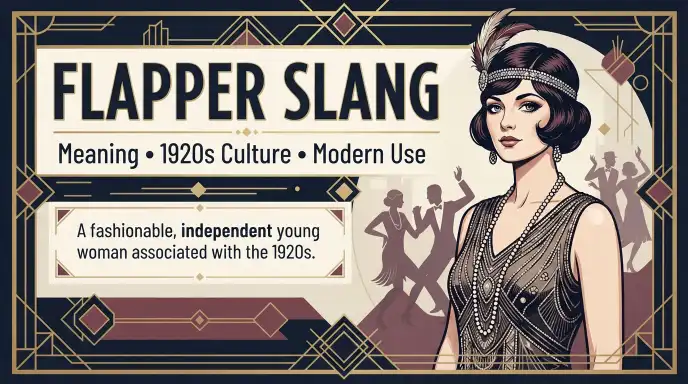
Flapper slang is mainly a historical term for a fashionable, independent, and unconventional young woman, especially one associated with the 1920s. Today, it is usually used when talking about the Jazz Age, vintage fashion, or a carefree and rebellious attitude.
People may search for flapper slang meaning after seeing the word in a historical article, vintage fashion post, movie, social media caption, or conversation.
Unlike many modern internet slang terms, flapper did not originate on TikTok or in texting. Its roots go back to an important period of social and cultural change.
The word is strongly linked with young women who challenged traditional expectations through fashion, dancing, social behavior, and greater independence.
Quick Answer: Flapper Slang
A flapper was a fashionable and unconventional young woman associated with the 1920s. In modern text, it usually refers to a vintage 1920s style, personality, or cultural image.
What Does Flapper Slang Mean in Text?
In text or casual conversation, flapper usually refers to a young woman with the fashionable, independent, lively, or unconventional image associated with the 1920s.
The word is closely connected with the Roaring Twenties and Jazz Age culture. It brings to mind short hairstyles, vintage dresses, dancing, jazz music, nightlife, and changing social attitudes.
For example:
“She looks like a flapper in that dress.”
Here, the speaker probably means that the person’s outfit has a strong 1920s or vintage appearance.
Someone might also say:
“She’s got total flapper energy.”
In this case, the word may describe more than clothing. It can suggest a confident, carefree, stylish, or rebellious personality.
Simple Meaning of Flapper
Flapper = a fashionable and unconventional young woman, especially one associated with the 1920s.
The word can also be used today in a playful way when someone has a strong vintage or Jazz Age style.
Is Flapper Actually Modern Slang?
Not in the same way as words such as “rizz,” “sus,” or “mid.”
Flapper is primarily a historical term. It became famous because of its connection with young women in the 1920s.
Modern speakers may use it casually or humorously, but it is not normally considered mainstream Gen Z texting slang.
Flapper Slang Full Form and Definition
Flapper has no full form. It is not an abbreviation, acronym, or shortened phrase.
The word itself developed into a cultural label for young women associated with changing social attitudes during the 1920s.
In simple terms, the historical meaning describes a young woman who was seen as fashionable, socially active, independent, and less restricted by older expectations.
What Does Flapper Stand For?
If someone asks, “What does flapper stand for?”, the answer is simple:
It does not stand for a phrase.
It is a standalone word.
Today, the word is most strongly associated with the image of a 1920s woman who embraced new fashions, social activities, and greater personal freedom.
Flapper Meaning Slang vs. Historical Meaning
There is a small difference between the historical meaning and modern casual use.
| Context | Meaning |
| 1920s history | A young woman associated with the social culture of the era |
| Vintage fashion | A 1920s-inspired woman or style |
| Modern conversation | A playful reference to someone stylish or carefree |
| Social media | Usually a vintage or historical reference |
| Texting | Usually depends on the surrounding context |
This distinction matters because flapper slang does not have one universal modern internet definition.
Is Flapper Rude, Offensive, or Neutral?
The word flapper is generally neutral when it is used to discuss history, fashion, or 1920s culture.
For example:
“The museum has an exhibition about flapper fashion.”
There is nothing insulting about this use.
However, the word can take on a negative tone when it is used to judge someone’s behavior. Historically, some people viewed flappers negatively because they believed these women were rejecting traditional social expectations.
When Flapper Sounds Positive
The term can sound positive when it focuses on:
- Fashion
- Confidence
- Independence
- Creativity
- Social freedom
- Vintage style
For example:
“She chose a beautiful flapper-inspired outfit.”
This is clearly a fashion-related use.
When Flapper Can Sound Negative
It may sound negative if someone uses the word to criticize a person’s behavior.
For example:
“He called her a flapper because he disapproved of her lifestyle.”
Here, the word carries a judgmental tone.
Therefore, context is more important than the word itself.
Where Is Flapper Commonly Used?
Unlike current internet slang, flapper is not commonly used in everyday texting or gaming conversations.
You are more likely to see it in content related to:
- 1920s history
- Jazz Age culture
- Vintage fashion
- Old movies
- Historical books
- Art Deco
- Costume parties
- Vintage photography
- Women’s social history
- Jazz music and dancing
Flapper on Social Media
The word can appear on platforms such as Instagram, TikTok, Pinterest, or Facebook when users post vintage-inspired content.
For example:
“Getting ready for a flapper-themed party!”
Here, the person is talking about a 1920s-inspired event.
Another example is:
“My new hairstyle gives major flapper vibes.”
This probably refers to a short, vintage-inspired hairstyle rather than the historical person herself.
Flapper in Text Messages
If someone sends:
“You look like a flapper ”
they may be commenting on a vintage outfit, hairstyle, or overall appearance.
The emoji or surrounding conversation can make the tone clearer.
It may be a compliment, a joke, or simply an observation about someone’s style.
Real-Life Examples of Flapper Slang
The meaning of flapper changes slightly depending on the situation. Looking at different examples can make the term easier to understand.
Friendly Example
Friend 1: “I love your dress!”
Friend 2: “Thanks! I’m going for a flapper look tonight.”
Here, flapper refers to a 1920s-inspired fashion style.
Casual Example
“She has that flapper energy.”
This suggests that the person seems stylish, lively, confident, or carefree.
Historical Example
“Flappers became an important symbol of changing social attitudes in the 1920s.”
This is a neutral historical use.
Social Media Example
“Our theme tonight is flapper fashion!”
The term clearly refers to 1920s clothing and culture.
Playful Example
“You stayed out dancing all night. You’re such a flapper!”
Here, the speaker is using the historical image of a lively, social young woman in a humorous way.
Fashion Example
“This dress has a classic flapper style.”
In this sentence, flapper describes a particular vintage fashion influence.
Origin and Background of Flapper Slang
The history of flapper slang goes back to the early 20th century. Although the exact origin of the word is uncertain, its best-known meaning developed around the 1920s.
The term became strongly associated with young women who represented a changing social culture after World War I.
The 1920s brought major changes in fashion, entertainment, music, and social behavior. Young women were increasingly associated with new styles and activities that challenged some older expectations.
Where Did the Word Flapper Come From?
The exact origin of flapper is debated.
One explanation connects the word with an earlier British use for a young girl or young woman. Another theory links it to older slang and the idea of someone who was lively or unconventional.
By the 1920s, however, the word had developed a much more recognizable cultural meaning.
It became closely connected with young women who wore modern fashions, enjoyed dancing and nightlife, and appeared less interested in following traditional social rules.
Why Did Flappers Become Famous?
Flappers became famous because they represented a visible change in women’s social and cultural roles.
They were commonly associated with:
- Shorter hairstyles
- Modern dresses
- Dancing
- Jazz music
- Makeup
- Nightlife
- Greater social independence
- New attitudes toward traditional behavior
However, it is important to avoid treating the flapper image as a description of every young woman in the 1920s.
The idea of the flapper was also shaped by newspapers, magazines, movies, advertising, and popular culture.
Flapper Slang and 1920s Culture
The flapper became one of the most recognizable symbols of the Roaring Twenties.
The period was known for major changes in entertainment and popular culture. Jazz became increasingly influential, while dancing and nightlife became important parts of the decade’s popular image.
Fashion also helped create the familiar image of a flapper.
Flapper Fashion
Flapper fashion is often associated with:
- Shorter hemlines
- Straight or loose-fitting dresses
- Bobbed hairstyles
- Cloche hats
- Beaded clothing
- Decorative accessories
- Bold makeup
These styles helped create the recognizable vintage image that people still associate with the word today.
A modern person wearing a 1920s-inspired dress might therefore describe the outfit as a flapper look.
Flappers and Dancing
Dancing was another important part of the popular flapper image.
The Charleston and other energetic dances became strongly associated with the Jazz Age.
This is why someone might use the word playfully today:
“She’s dancing like a flapper tonight.”
The sentence does not necessarily mean that the person is literally a 1920s woman. It compares her behavior or appearance with the cultural image of a flapper.
Flapper vs. Similar Slang Terms
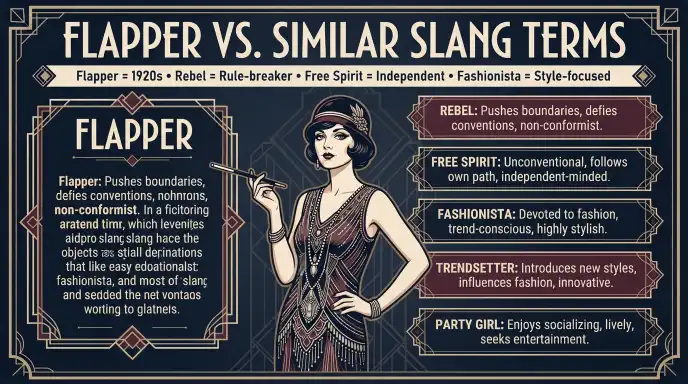
It has a very specific historical meaning, so it should not automatically be treated as a synonym for every word describing a fashionable or independent woman.
| Term | Meaning | Main Difference |
| Flapper | Fashionable and unconventional young woman associated with the 1920s | Strong historical connection |
| Rebel | Someone who resists rules or authority | Much broader meaning |
| Trendsetter | Someone who influences fashion or popular trends | Focuses on influence |
| Free spirit | Someone who values independence and freedom | Not connected to one era |
| Fashionista | Someone strongly interested in fashion | Focuses mainly on style |
| Party girl | Someone who enjoys parties and nightlife | Modern and broader term |
Flapper vs. Rebel
A flapper could certainly be viewed as rebellious, but the two terms do not mean exactly the same thing.
Rebel can describe someone who challenges rules in almost any area of life.
Flapper, on the other hand, points specifically toward the cultural image of the 1920s.
For example:
“She is a rebel.”
This tells you that the person challenges rules.
But:
“She looks like a flapper.”
mainly suggests a 1920s-inspired appearance or personality.
Flapper vs. Free Spirit
A free spirit is someone who values personal freedom and does not like being controlled by social expectations.
The idea can overlap with the historical image of a flapper.
However, free spirit is much broader and can describe anyone, regardless of age, gender, or historical period.
Flapper vs. Fashionista
A fashionista is someone who is very interested in fashion.
A flapper can be fashionable, but fashion is only one part of the historical meaning.
The word flapper also carries ideas about social culture, independence, and the 1920s.
Why Did People Use the Word Flapper?
The term became popular because it provided a simple way to describe a new cultural image of young women.
After World War I, society was changing in many ways. Women’s public roles were changing, popular entertainment was evolving, and young people were increasingly exposed to new forms of music, fashion, and social activity.
The flapper became a symbol of these changes.
The Positive Image of a Flapper
Some people viewed flappers as symbols of:
- Independence
- Modernity
- Confidence
- Freedom
- Fashion
- Youthful energy
This helped make the flapper a memorable cultural figure.
The Negative Image of a Flapper
Not everyone viewed the trend positively.
Some older generations considered flappers too rebellious or too willing to reject traditional expectations.
As a result, the word could sometimes be used critically.
This is one reason tone and context are important when interpreting the word in historical writing.
When Should You Avoid Using Flapper?
There is generally no major safety concern with the word flapper, but it is not always the clearest way to describe a modern person.
If you are talking about someone’s personality, choose a more precise word when possible.
For example, instead of:
“She’s a flapper.”
you could say:
“She’s very independent.”
if independence is what you actually mean.
Situations Where Flapper Works Well
The term is appropriate when discussing:
- 1920s history
- Jazz Age culture
- Vintage clothing
- Historical movies
- Vintage-themed parties
- Art Deco events
- 1920s hairstyles
- Historical literature
Situations Where Another Word May Be Better
A different word may be clearer when you are describing:
- A person’s current personality
- Someone’s fashion without a historical connection
- A person’s independence
- Someone who enjoys parties
- A modern trendsetter
Using a more precise term avoids confusion.
Polite Alternatives to Flapper
If you want to describe someone without using a historical label, several alternatives may fit better.
Depending on your intended meaning, you could use:
- Independent woman
- Free spirit
- Confident person
- Stylish person
- Fashionable woman
- Trendsetter
- Bold person
- Carefree person
- Vintage-style woman
Choosing the Right Alternative
The best alternative depends on what you want to communicate.
If you mean someone’s fashion, use stylish or fashionable.
If you mean someone’s personality, use confident, independent, or free spirit.
This is usually more accurate than using flapper outside a historical or vintage context.
Why People Still Use Flapper Today?
The word has survived because the image of the 1920s flapper remains recognizable.
Even people who know little about 1920s history may recognize the typical combination of short hair, vintage dresses, jazz, dancing, and Art Deco style.
Modern fashion and entertainment also continue to revisit the decade.
Flapper in Movies and Entertainment
Films, television shows, documentaries, theater productions, and themed events often use the flapper image to represent the 1920s.
When a character is dressed in a beaded dress with a bob haircut and attends a jazz club, audiences may immediately recognize the visual reference.
This makes flapper useful as a short cultural description.
Flapper in Modern Fashion
Fashion designers and costume creators sometimes use flapper-inspired to describe clothing influenced by 1920s designs.
For example:
“The collection features flapper-inspired dresses.”
Here, the word clearly refers to historical fashion rather than modern slang.
Is Flapper Safe for Social Media?
Yes. Flapper is generally safe for normal social media use.
It is not inherently a vulgar term, slur, or offensive abbreviation.
The main issue is not platform safety but social context.
A post about vintage fashion is unlikely to cause confusion:
“My flapper-inspired dress for the 1920s party.”
However, using the word to label another person’s behavior could sound strange or judgmental.
How to Use Flapper Clearly Online
If you are using the word in a caption or post, adding context can make your meaning obvious.
For example:
“1920s flapper style for tonight’s vintage party.”
This is clearer than simply writing:
“I’m a flapper.”
The first sentence tells readers that the reference is about historical fashion and culture.
Flapper in Modern Texting
Although flapper is not common modern texting slang, you may still see it in messages about vintage fashion, history, parties, or someone’s personality.
The meaning usually comes from the surrounding conversation.
For example:
“Your outfit is giving flapper vibes!”
This most likely means the outfit looks inspired by 1920s fashion.
Someone might also write:
“We’re going full flapper for the party.”
Here, flapper describes a 1920s-themed style.
Flapper in Casual Chats
In casual conversations, the word can be playful.
For example:
“You really love dancing. Total flapper energy ”
The speaker is probably not using the historical definition literally. Instead, they are borrowing the image of a lively, fashionable woman from the Jazz Age.
Flapper in Online Discussions
Online, the word is more likely to appear when people discuss:
- Vintage clothing
- 1920s history
- Jazz culture
- Old Hollywood
- Historical fashion
- Costume ideas
- Period dramas
It is therefore better understood as a historical term sometimes used casually, rather than as a major current internet slang word.
Impact of Using Flapper in Communication
Words connected to history can carry cultural associations beyond their basic dictionary meaning.
Using flapper can immediately make people think of the 1920s, vintage fashion, and social change.
Positive Impact
In the right setting, the word can communicate an idea quickly.
For example:
“The event has a flapper theme.”
Most people familiar with the term will understand that the event probably involves 1920s-inspired clothing and entertainment.
Possible Misunderstanding
The problem comes when the historical context is missing.
If someone tells another person:
“You’re a flapper.”
the listener may not know if it is meant as a compliment, joke, or criticism.
That is why descriptive phrases such as “flapper-inspired” or “1920s-style” can sometimes be clearer.
Context Makes the Meaning Clear
Compare these two sentences:
“She wore a flapper-inspired dress.”
and
“She’s a flapper.”
The first clearly refers to fashion.
The second could refer to personality, appearance, or behavior.
When communicating online, adding a few words can prevent confusion.
Common Misunderstandings About Flapper Slang
Because flapper is an old term, people sometimes assume it is a modern acronym or hidden texting abbreviation.
It is not.
Flapper Is Not an Acronym
There is no standard phrase behind each letter of the word.
So searches such as “flapper full form” should not be treated like searches for abbreviations such as “LOL” or “BRB.”
Flapper Does Not Automatically Mean Party Girl
The popular image of flappers includes nightlife and dancing, but the word has a broader cultural meaning.
Calling someone a flapper does not simply mean that they enjoy parties.
The historical term also involves fashion, youth culture, independence, and changing social expectations.
Not Every 1920s Woman Was a Flapper
The term describes a particular cultural image rather than every young woman who lived during the 1920s.
Many women did not follow the lifestyle or fashion associated with flappers.
This distinction is important when discussing the history accurately.
Flapper Slang in Popular Culture
The flapper image continues to appear in modern popular culture.
Its distinctive fashion makes it easy for filmmakers, designers, and advertisers to communicate the atmosphere of the 1920s.
Flapper-Inspired Characters
A character dressed in a short vintage dress, bobbed hairstyle, and decorative accessories may be described as flapper-inspired.
This does not necessarily mean the character is historically accurate.
Modern entertainment often combines different elements of 1920s fashion and culture to create a recognizable aesthetic.
Flapper-Themed Events
The word is also common in event descriptions.
Examples include:
- Flapper parties
- 1920s-themed weddings
- Jazz nights
- Vintage dance events
- Roaring Twenties parties
- Art Deco celebrations
In these situations, flapper usually refers to the visual and cultural style of the period.
Flapper Slang Examples by Tone
The same word can communicate different feelings depending on how it is used.
| Tone | Example | Meaning |
| Friendly | “You look like a flapper tonight!” | Compliment about vintage style |
| Casual | “I’m going for a flapper look.” | 1920s-inspired fashion |
| Playful | “Total flapper energy!” | Lively or carefree personality |
| Historical | “Flappers became famous in the 1920s.” | Historical reference |
| Negative | “He used flapper as an insult.” | Judgmental use |
| Social media | “Flapper-inspired makeup tutorial.” | Vintage beauty style |
The surrounding words usually make the intended tone clear.
When to Use Flapper in a Sentence?
Use flapper when the historical or vintage meaning is relevant.
Good examples include:
“The museum displayed photographs of famous flappers.”
“She wore a flapper-inspired dress to the party.”
“The movie shows the changing role of women during the flapper era.”
“Her costume has a classic flapper style.”
These examples make the context clear.
When a Different Word Is Better
If you are describing someone in modern life, a more direct term may be better.
Instead of:
“She is a flapper.”
you could say:
“She is very independent.”
Or:
“She has a vintage style.”
Or:
“She is a real free spirit.”
The alternative depends on the exact idea you want to express.
Is Flapper a Gen Z Slang Word?
No, flapper is not generally considered Gen Z slang.
Gen Z slang often develops through online communities, social media, gaming, texting, and popular internet culture.
Flapper is different because its main meaning comes from a historical period nearly a century ago.
A younger person might still use the word online, but that does not automatically make it Gen Z slang.
Why Younger People May Still Use It
You may see younger users use flapper because of:
- Vintage fashion trends
- 1920s-themed parties
- Historical content
- Period movies
- Social media aesthetics
- Costume ideas
- Interest in retro culture
In these cases, the word is being reused rather than newly invented.
Is Flapper Used in Gaming?
Flapper is not a common gaming slang term.
You generally should not assume that it has a special meaning in gaming chats on platforms such as Discord or in multiplayer games.
If it appears in a gaming conversation, the meaning may depend on the specific game, username, character, or community.
For example:
“Our character has a flapper-style costume.”
Here, the meaning is probably related to vintage fashion.
Without additional context, there is no universal gaming definition of flapper.
Is Flapper Used on TikTok and Instagram?
Yes, but usually as a historical or aesthetic reference rather than everyday slang.
Creators may use terms such as:
- Flapper fashion
- Flapper dress
- Flapper makeup
- Flapper hairstyle
- 1920s flapper
- Flapper-inspired outfit
These phrases generally point toward the visual style of the 1920s.
A caption such as:
“Trying a flapper-inspired makeup look”
is clearly about vintage beauty.
FAQs About Flapper Slang
Q1. What does flapper slang mean?
Flapper slang refers mainly to a fashionable and unconventional young woman associated with the 1920s. Today, it can also describe a vintage or 1920s-inspired style.
Q2. What does flapper mean in text?
In text, flapper usually refers to a 1920s-style woman, vintage fashion, or someone with a carefree and lively personality. The exact meaning depends on context.
Q3. What does flapper stand for?
Flapper does not stand for a phrase. It is a standalone word and is not an acronym or abbreviation.
Q4. Is flapper a bad word?
No. Flapper is generally neutral, especially when discussing 1920s history or fashion. It can sound negative if someone uses it to judge another person’s behavior.
Q5. Is flapper modern slang?
Not usually. Flapper is mainly a historical term. Modern speakers may use it playfully, especially when discussing vintage fashion or 1920s culture.
Q6. Why were women called flappers?
The exact origin of the term is uncertain, but by the 1920s it became associated with young women who represented changing fashions, social habits, and attitudes toward traditional expectations.
Q7. What is flapping in slang?
In slang, flapping can mean moving, waving, or behaving in an excited or uncontrolled way. Its exact meaning depends on the context.
Q8. What does flipper mean in slang?
Flipper can refer to someone or something that quickly changes, switches, or resells things, depending on the context. It may also have specific meanings in different communities.
Conclusion
The flapper slang meaning is closely connected with the social and cultural changes of the 1920s. A flapper was commonly understood as a fashionable, unconventional young woman associated with the Jazz Age.
Today, the word is mostly found in historical discussions, vintage fashion, entertainment, costume events, and social media posts about 1920s culture. It can also be used playfully to describe someone with a vintage, confident, lively, or carefree style.
Importantly, flapper is not an acronym and does not have a traditional full form. It is also not one of the most common forms of modern Gen Z or internet slang.
If you see the word in a text or social media post, look at the surrounding context. In most cases, the reference will be connected to 1920s fashion, history, independence, or vintage culture.
Read More Articles:
- Awesome Slang Meaning: Complete Guide with Examples
- Slang for Women Meaning in Text: Common Terms Explained
- Snowbunny Slang: The Full Meaning Breakdown

Hi, I’m Tyler Brooks, a writer specializing in Gen Z culture and internet slang. I track trending terms across TikTok and social media to explain their real-world meanings. My goal is to provide clear, accurate, and up-to-date definitions that help readers understand modern online language.