Metal slang usually refers to heavy metal music or something connected to its loud, intense, rebellious style.
In some slang and rap contexts, metal can also mean a gun or weapon. The exact meaning depends on the sentence, speaker, and community using the word.
If you saw someone write “That song is metal” or “He’s into metal,” you may wonder what metal slang means. The answer depends on the context.
Most often, metal is a short, casual way to talk about heavy metal music. It can describe the music itself, a metal fan, or a style linked with metal culture. Dictionaries also recognize metal as an informal shortening of heavy metal.
Online, people may also use metal in a broader way to describe something extremely intense, dark, wild, or hard-core. That use is more informal and depends heavily on the community.
There is another meaning worth knowing. In some rap and street-slang sources, metal is used to mean a gun or weapon. This meaning is not the same as the music-related meaning and can usually be understood from the surrounding words.
Quick Answer Table
| Question | Answer |
| Meaning | Usually heavy metal music; sometimes something intense or extreme |
| Other slang meaning | A gun or weapon in some rap/street contexts |
| Tone | Usually casual; can be positive, neutral, or serious |
| Used By | Music fans, online communities, and some rap/slang communities |
| Platforms | TikTok, Instagram, YouTube, Reddit, Discord, X, chats |
| Offensive? | Usually no, but the weapon meaning can be serious |
| Pronunciation | MET-uhl |
| Formal? | No; use context-specific wording in formal writing |
The important point is that metal is not one fixed slang definition. A music fan saying “That riff is metal” is talking about a style or sound. A lyric or street-slang conversation may use the word differently.
What Does Metal Mean in Slang?
In the most common slang use, metal is a shortened way of referring to heavy metal music.
For example:
“I listen to metal.”
This normally means:
“I listen to heavy metal or metal music.”
The word can also describe something connected to metal culture.
For example:
“That jacket is so metal.”
Here, the speaker may be talking about a dark or classic metal-inspired look, especially if the jacket has band imagery, black clothing, studs, or other features associated with the scene.
The exact meaning comes from context. Metal is also an ordinary English word for a hard material such as iron, steel, or gold, so it is not automatically slang whenever you see it.
Metal as a Music Slang Term
The music meaning is one of the clearest uses of the word.
People often say metal instead of heavy metal when the conversation is already about music.
Examples
- “Do you listen to metal?”
- “This band plays metal.”
- “That guitar solo is pure metal.”
- “My brother has been into metal for years.”
In these examples, metal refers to a broad music category rather than the physical material.
The term can cover many different styles, including heavy metal and numerous related subgenres. So someone saying “I like metal” does not necessarily tell you which particular metal style they prefer.
Why Does Metal Sometimes Mean Something Intense?
You may also see metal used as an informal adjective.
Someone might say:
“That was metal.”
The speaker may mean that something felt extreme, dark, brutal, wild, or strongly connected to metal culture.
This is more of a cultural use than a strict dictionary definition. It often works because heavy metal has long been associated with powerful sounds, intense performances, and darker or rebellious themes.
For example:
“The movie scene was so metal.”
The person probably is not saying that the scene was literally made of metal. They are using metal as a cultural comparison.
This meaning can be playful. It may also depend on the speaker’s taste and the community they belong to.
Where Metal Is Used
The meaning usually stays similar across social platforms, so there is no need to treat every platform as having a completely different definition.
| Platform | How It’s Used | Example |
| TikTok | Music, style, humor, intense moments | “That transition was metal.” |
| Captions, music posts, fashion | “Metal night 🤘” | |
| YouTube | Music discussions and reviews | “I love old-school metal.” |
| Music communities and discussions | “What metal bands do you recommend?” | |
| Discord | Casual music or gaming chats | “Anyone here listen to metal?” |
| X | Short reactions and music posts | “That performance was metal.” |
| Personal conversations | “My cousin is really into metal.” |
The platform itself usually does not change the core meaning. The conversation around the word matters more.
Metal Slang in Rap and Street Language
There is another meaning that readers should not confuse with the music sense.
Some rap and slang dictionaries use metal as a word for a gun or weapon. Rap Dictionary, for example, lists metal as slang for a gun or weapon.
This meaning is usually easier to identify when the surrounding sentence talks about carrying, firing, hiding, or possessing something.
For example:
“He was carrying metal.”
In a music discussion, that could sound like a reference to metal objects. In a rap or street-slang context, however, it may refer to a weapon.
This is why you should not assume that every use of metal slang refers to heavy metal music.
Metal vs. Metalhead
These words are related, but they are not interchangeable.
Metal usually refers to the music or the culture surrounding it.
Metalhead refers to a person who is a fan of heavy metal music.
American Heritage defines metalhead as a slang term for a fan of heavy metal music, while Dictionary.com also lists it as a slang term for a heavy metal fan.
| Term | Meaning |
| Metal | Heavy metal music or its culture |
| Metalhead | A person who loves or strongly identifies with metal music |
| Heavy metal | A genre/style of rock music |
| Metal music | A broad term covering metal styles and subgenres |
Example
“Nora listens to metal.”
This tells us about her music taste.
“Nora is a metalhead.”
This describes Nora as a fan of the genre.
Is Metal Slang Positive or Negative?
Usually, metal is neither automatically positive nor negative.
Its tone depends on how it is used.
When someone says:
“That guitar solo is metal!”
they are probably praising it.
When someone says:
“That movie was metal.”
they may be expressing excitement about something intense or dark.
But the weapon-related meaning can have a much more serious tone.
Context is therefore more important than the word alone.
Is Metal Slang Rude or Offensive?
The music-related use of metal is generally not offensive.
Calling someone a metalhead is also normally a neutral or positive description when the person enjoys the music.
The word becomes more sensitive when it is being used as slang for a weapon. In that setting, the subject matter itself may be serious.
It is also possible for slang to carry a different tone inside a particular community. If you are unsure what someone means, look at the surrounding sentence instead of assuming.
How Do You Pronounce Metal?
Metal is pronounced roughly like:
MET-uhl
Cambridge gives the American pronunciation as approximately /ˈmet̬.əl/ and the British pronunciation as /ˈmet.əl/.
The pronunciation does not change when the word is used as slang.
Is Metal Formal or Informal?
When metal means heavy metal music, it is common and widely understood in casual speech.
For example:
“I listen to metal.”
is perfectly natural.
In formal writing, you may want to be more specific:
“I listen to heavy metal music.”
That makes the meaning clear for readers who may not know the shortened form.
The same rule is even more important with the weapon-related meaning. In serious or professional writing, avoid slang when a clear term is available.
Metal Slang and Metal Culture
The word metal can represent more than music in casual conversation.
Metal culture can include:
- Music
- Concerts
- Band shirts
- Dark fashion
- Album artwork
- Guitar-focused music
- Subgenres
- Fan communities
- Concert culture
This is why someone can call clothing, artwork, a concert moment, or even a movie scene “metal.”
The speaker is often making a cultural comparison rather than giving a literal description.
Real-Life Examples of Metal Slang
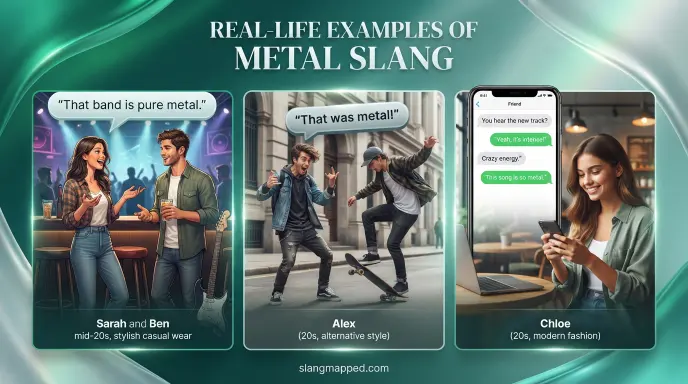
Text Message
Aiden: “What kind of music are you into?”
Marcus: “Mostly metal and punk.”
Here, metal clearly means metal music.
TikTok Comment
“That ending was metal 🤘”
The commenter is using metal as a reaction to something intense, dramatic, or connected to metal culture.
Instagram Caption
“Friday night = metal and loud guitars.”
Here, the meaning is directly related to music.
Discord Chat
Priya: “What are you listening to?”
Sam: “Some old metal records.”
This is another straightforward music use.
Rap Context
“The lyric mentions carrying metal.”
If the surrounding lyrics discuss weapons, metal may have the weapon-related slang meaning instead of the music meaning.
The key lesson is simple: read the surrounding words before deciding what “metal” means.
Metal vs. Heavy Metal vs. Metalhead
These terms can look similar, but they describe different things.
| Term | What It Refers To | Example |
| Metal | A casual name for metal music | “I listen to metal.” |
| Heavy metal | The full music genre name | “Heavy metal has many subgenres.” |
| Metalhead | A fan of metal music | “He is a metalhead.” |
| Metal style | A look or cultural aesthetic | “Her outfit has a metal style.” |
A common mistake is using metalhead when you mean the music itself.
Common Mistakes With Metal Slang
Mistake 1: Assuming It Always Means Music
Not every use of metal refers to heavy metal.
In some rap and slang contexts, it can refer to a gun or weapon.
Mistake 2: Confusing Metal With Metalhead
A metalhead is a person.
Metal can refer to the music or its culture.
Mistake 3: Treating Every “Metal” Use as Slang
“Metal” is also an ordinary English noun referring to materials such as iron, steel, gold, and other metals.
For example:
“The door is made of metal.”
That is a literal use, not slang.
Mistake 4: Assuming “Metal” Always Means Something Violent
The music-related slang is not automatically about violence. It can simply describe a music taste or aesthetic.
Mistake 5: Ignoring Context
The sentence around the word often gives you the answer.
Is Metal Slang Still Used?
Yes, metal remains a normal short form for metal music, especially among music fans.
It is not necessary to treat the term as a new internet trend. The music-related use is connected to the established term heavy metal, and dictionaries recognize metal as an informal short form.
The broader use of metal as a reaction meaning something intense or extreme is more context-dependent.
The weapon-related use is also community-specific and should not be assumed whenever the word appears.
What Emoji Goes With Metal Slang?
The most recognizable emoji choice for metal music is:
🤘
Other emojis may also fit depending on the post:
- 🤘 rock/metal music
- 🎸 guitar or music
- 🔥 impressive or intense
- 🖤 dark or alternative aesthetic
- 🎶 music
There is no single official “metal slang emoji.” The best choice depends on the message.
People Also Ask About Metal Slang
Q1. What does metal mean in slang?
Most commonly, metal is a casual short form of heavy metal music. It can also describe something associated with metal culture or an intense, extreme style. In some rap and street-slang contexts, it can mean a gun or weapon, so the surrounding context matters.
Q2. Does metal mean heavy metal?
Yes. In informal use, metal can be a shortened form of heavy metal. For example, “I listen to metal” commonly means “I listen to heavy metal or metal music.” Dictionaries recognize this informal music-related use.
Q3. What is a metalhead?
A metalhead is a fan of heavy metal music. It describes a person rather than the music itself. Someone can say, “I listen to metal,” without calling themselves a metalhead. The word is generally informal and is commonly used within music culture.
Q4. Is calling something metal a compliment?
It can be. When someone says “That was metal,” they may be praising something for being intense, powerful, dark, wild, or strongly connected to metal culture. The meaning is informal, so the tone depends on the speaker and situation.
Q5. Does metal mean a gun in slang?
In some rap and street-slang contexts, yes. Some slang references use metal to mean a gun or weapon. This is different from the common music-related meaning, so readers should use the surrounding words to determine which meaning applies.
Q6. Is metal slang offensive?
The music-related use is generally not offensive. Metal and metalhead are normally casual terms connected with music. The weapon-related use is more serious because it refers to a weapon. Always consider the context before interpreting or repeating slang.
Q7. What does “that is metal” mean?
“That is metal” usually means something feels very intense, dark, extreme, wild, or connected to heavy metal culture. It may describe music, fashion, artwork, a movie scene, or an unusual event. It is a casual expression rather than a strict dictionary definition.
Key Takeaways
- Metal slang most commonly refers to heavy metal music.
- Metal can also describe something intense, dark, or strongly connected to metal culture.
- Metalhead means a fan of heavy metal music.
- In some rap and street-slang contexts, metal can mean a gun or weapon.
- Always check the surrounding words because metal also has its normal literal meaning.
Conclusion
Metal slang has more than one possible meaning, which is why context matters.
For most casual music conversations, metal means heavy metal or metal music. You may also see it used to describe a dark, intense, or extreme style associated with metal culture. Someone who loves this kind of music may be called a metalhead.
There is also a less common slang meaning in some rap and street contexts, where metal can refer to a gun or weapon.
The safest way to understand the word is to look at the whole sentence. If the conversation mentions bands, guitars, concerts, or music, the music meaning is likely. If the context discusses weapons, the word may have the other slang meaning.
Once you know the context, metal slang is much easier to understand and use correctly.
You May Also Like:
- 304s Slang: Meaning, Origin, and How It’s Used
- Baby Fever Slang: What It Means in Texting, TikTok & Real Life
- Slang for Diamonds: Meanings, Terms, and Examples

Hi, I’m Tyler Brooks, a writer specializing in Gen Z culture and internet slang. I track trending terms across TikTok and social media to explain their real-world meanings. My goal is to provide clear, accurate, and up-to-date definitions that help readers understand modern online language.