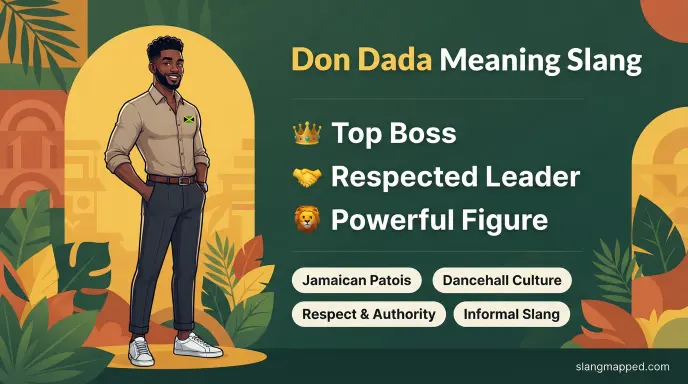
Don dada meaning slang refers to a top boss, highly respected person, or powerful leader. You may see this phrase in Jamaican Patois, dancehall music, social media posts, or casual conversations.
It can describe someone who has strong influence, high status, or a respected position.The phrase can also be used in a playful way. For example, a friend who wins a competition or handles a difficult task might jokingly be called “don dada.”
In other contexts, the term can have a more serious meaning linked to authority or a powerful figure.
Understanding the context is important because don dada does not always mean exactly the same thing. Its tone can be respectful, confident, humorous, or serious depending on how it is used.
In this guide, you’ll learn what don dada means, where it comes from, how people use it, and how it compares with similar slang such as OG.
Quick Answer
Don dada is Jamaican Patois slang for a top boss, highly respected person, or someone seen as being at the highest level in a group or field. It can describe a powerful leader or, in casual use, someone who is very successful, confident, or influential.
| Question | Answer |
| Meaning | Top boss, leader, or highly respected person |
| Tone | Respectful, confident, boastful, or playful |
| Used By | People familiar with Jamaican Patois, dancehall, Caribbean or global slang |
| Common Places | Music, casual speech, social media, captions, comments |
| Offensive? | Not inherently, but context matters |
| Origin | Jamaican Patois and dancehall culture |
| Similar Words | Boss, big man, OG, kingpin, top dog |
The important part is that don dada is not simply another way to say “dad.” In this phrase, it carries an idea of rank, influence, and respect. Jamaican Patois sources also record don dada as “top boss” and, in some contexts, a kingpin or crime boss.
What Does Don Dada Mean in Slang?
Don dada means a person who is considered the top boss, leader, or most respected person in a particular setting.
It can be used for someone who has earned a strong reputation or has a lot of influence.
For example:
“He’s the don dada of the dancehall scene.”
This suggests that the person is viewed as a major or highly respected figure in that area.
The phrase can also be used outside music. Someone might jokingly call a successful business owner, athlete, artist, or friend a “don dada.”
The exact meaning depends on the situation. In a serious Jamaican Patois context, it can carry a stronger sense of authority. In everyday internet slang, it may simply praise someone for being successful or impressive.
Don Dada Pronunciation
It is commonly pronounced roughly like:
don DAH-dah
The second word may also be written dadda in Jamaican Patois sources. Jamaican Patwah lists “don dadda” as an alternate spelling.
Do not worry about making the pronunciation sound perfectly English. The phrase comes from Jamaican Patois, so its natural pronunciation is connected to Jamaican speech.
Where Did Don Dada Come From?
Don dada has Jamaican Patois roots and became strongly associated with Jamaican dancehall culture. Jamaican Patwah records the expression as slang for the highest-ranking boss or most respected person.
The phrase became especially visible through Jamaican dancehall music.
One important example is Jamaican deejay Super Cat, whose stage identity became closely linked with “Don Dada.” His 1992 album Don Dada was released by Columbia Records, and the album included the title track “Don Dada.”
Jamaican music coverage has also referred to Super Cat as “Don Dada” among dancehall audiences.
This music history matters because it helped carry the expression beyond Jamaica and into wider reggae, dancehall, hip-hop, and pop-culture conversations.
Is the Origin Completely Clear?
The phrase’s Jamaican Patois use is well documented, but simple online explanations sometimes give different theories about the individual words.
It is safer to understand the established usage rather than assume a precise literal translation for every part of the phrase.
The important meaning is high status, authority, leadership, or respect.
What Does Don Mean in Don Dada?
The word don is associated with a powerful or respected leader. In English, don can also be a title of respect, while in crime-related contexts it can refer to a powerful boss.
In Jamaican slang, don can refer to an influential community leader or powerful figure.
That is why don dada carries a stronger meaning than simply calling someone “good” or “cool.”
It suggests that the person has status or authority.
Is Don Dada a Compliment?
Usually, don dada can be a compliment when someone uses it to praise another person’s status, talent, influence, or success.
For example:
“You closed that deal again? Don dada!”
Here, the speaker is praising the person’s success.
But the phrase can also be sarcastic.
If someone is acting bossy, another person might say:
“Okay, don dada. We get it.”
In that case, the speaker is making fun of the person’s attitude.
So the phrase is not automatically positive. Tone and context decide how it feels.
Is Don Dada Positive or Negative?
It can be either positive or negative depending on context.
| Context | Likely Meaning | Tone |
| Praising an artist | Highly respected or influential | Positive |
| Praising a winner | Top performer | Positive |
| Talking about a leader | Powerful or authoritative | Neutral/positive |
| Calling someone bossy | Acting too important | Negative/playful |
| Referring to a criminal leader | Crime boss or kingpin | Negative/serious |
| Friendly joking | “Big boss” | Playful |
Jamaican Patois references include both general “top boss” meanings and more specific criminal meanings such as kingpin or crime lord.
That distinction is important. Don dada does not always mean “good person.” It describes status or authority, and that authority can be viewed positively, negatively, or simply as part of a character or persona.
Don Dada in Music and Pop Culture
Music is one of the most important places where people encounter the expression.
Super Cat’s connection to the phrase is especially notable. His 1992 album Don Dada helped associate the expression with his dancehall identity, while his music reached audiences outside Jamaica.
The phrase can therefore appear in:
- Dancehall music
- Reggae culture
- Hip-hop references
- Artist nicknames
- Music discussions
- Lyrics and song titles
- Social media captions
In music, don dada can communicate confidence, dominance, reputation, and authority.
It may be literal within the story of a song or simply a boastful title.
Where Is Don Dada Used?
The meaning usually stays close to “top boss” or “highly respected person,” so separate platform definitions are not necessary.
| Platform or Setting | How It May Be Used | Example |
| TikTok | Praise or playful nickname | “Bro thinks he’s don dada ” |
| Caption or comment about success | “Don dada energy today.” | |
| X | Comment about an influential person | “That man is the don dada of the game.” |
| Casual message to a friend | “Look at you, don dada!” | |
| YouTube | Music or culture discussions | “He was known as a don dada.” |
| Discord | Friendly gaming or group talk | “Don dada carried the whole team.” |
| Real life | Nickname or praise | “He’s the don dada around here.” |
Not every use on these platforms should be treated as authentic Jamaican Patois. People often borrow slang from music and online culture and use it loosely.
Don Dada in Text Messages
In texting, don dada can be a quick way to praise someone or joke about their confidence.
Example
Marcus: “I just finished the whole project before lunch.”
Dylan: “Okayyy, don dada ”
Here, the phrase means something like “Look at the boss!”
It does not necessarily suggest that Marcus is literally a leader.
The speaker is using the phrase as playful praise.
Don Dada on Social Media
On social media, the phrase can work as a caption, comment, or nickname.
Example
Instagram caption:
“Big win today. Don dada mode.”
This gives the caption a confident, playful tone.
A comment might say:
“My guy really came through like the don dada.”
Again, the phrase is being used metaphorically. The person is being praised for doing something impressive.
When Don Dada Has a Stronger Meaning
The phrase should not always be reduced to “cool guy.”
In Jamaican Patois references, don dada can refer to a highest-ranking boss, and some entries give meanings such as kingpin or crime lord.
That means the phrase can carry a darker meaning when the surrounding conversation involves:
- Street hierarchy
- Criminal organizations
- Gang culture
- Crime stories
- Violent lyrics
- Underworld characters
Context is the key.
If someone says:
“He runs the whole organization. He’s the don dada.”
the phrase may describe actual authority rather than simply saying the person is impressive.
Don Dada vs. Don
These words are related, but they are not always interchangeable.
| Term | General Meaning | Strength |
| Don | Boss, leader, respected figure | Strong |
| Don dada | Top boss or highest-ranking respected figure | Stronger |
| Boss | Person in charge | General |
| OG | Respected or established person | Informal |
| Top dog | Person at the highest position | Informal |
| Kingpin | Powerful leader, often in a criminal context | Very strong |
Don dada has a distinct Jamaican Patois and dancehall cultural connection, so replacing it with “boss” can lose some of its cultural meaning.
Don Dada vs. Big Boss
These phrases can sound similar, but they have different backgrounds.
Big boss is ordinary English slang for someone with authority.
Don dada has a stronger connection to Jamaican Patois and dancehall culture.
For example:
“She’s the big boss at work.”
This is a normal informal English description.
“She’s the don dada of the scene.”
This sounds more like a slangy statement about influence, reputation, or dominance.
Don Dada vs. OG
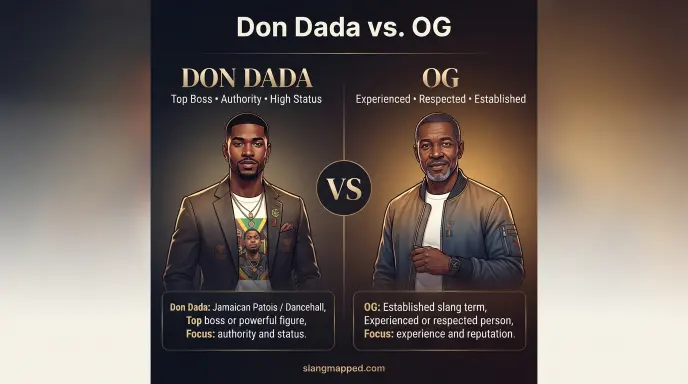
OG often describes someone who is respected because they have been around for a long time or helped establish something.
Don dada focuses more on being at the top or having strong authority and respect.
A person could be both.
For example:
“He’s an OG in the scene and still the don dada.”
That suggests both long-standing respect and high status.
Real-Life Examples of Don Dada
Text Message
Nia: “I got the highest score again.”
Kayla: “Don dada strikes again ”
The phrase is playful praise. Kayla is treating Nia like the top person in the group.
Social Media Comment
Andre: “Nobody is touching his performance this season.”
Malik: “Don dada behavior.”
Here, the phrase highlights dominance or exceptional performance.
Music Discussion
Tasha: “Why do people call Super Cat Don Dada?”
Jordan: “It became part of his dancehall identity and is linked with his status and influence.”
This use points toward the phrase’s cultural and musical background.
Friendly Conversation
Leo: “I paid for everyone’s dinner.”
Sam: “Look at don dada over here!”
The speaker is jokingly calling Leo the boss.
Sarcastic Use
Maya: “Everyone has to do exactly what I say.”
Priya: “Okay, don dada. Take it easy.”
Here, the phrase is sarcastic. Priya is teasing Maya for acting too powerful.
Gaming Chat
Ethan: “I carried that entire match.”
Noah: “Relax, don dada ”
The phrase is being used humorously rather than as a serious title.
Common Mistakes With Don Dada
Mistake 1: Thinking It Means “Dad”
The word dada can have other meanings in different languages and contexts, but don dada as a phrase has a specific slang meaning connected with status and authority.
Do not translate it word-for-word without considering context.
Mistake 2: Assuming It Always Means “Gangster”
The phrase can appear in street or crime-related contexts, but it can also be used more broadly for respected or influential people.
Context determines if the meaning is serious, metaphorical, or playful.
Mistake 3: Treating It as Standard Formal English
Don dada is informal slang.
It is not a phrase you would normally use in a formal report, business letter, academic paper, or professional presentation.
Mistake 4: Using It Without Understanding the Culture
Because the phrase comes from Jamaican Patois and dancehall culture, using it casually without understanding its background can sound forced.
It is better to know what the phrase means before using it.
Mistake 5: Assuming Everyone Uses It
Not every English speaker knows don dada. Its meaning is more familiar in communities influenced by Jamaican music, Caribbean culture, and global slang.
Is Don Dada Offensive?
The phrase itself is not inherently offensive.
However, context matters.
Using it to praise someone’s skill or success is usually very different from using it to describe a criminal leader.
It can also sound mocking if you use it sarcastically.
There is another important point: Jamaican Patois is a real language variety with its own cultural history. Using Jamaican expressions as random “street talk” without understanding their context can come across as insensitive or unnatural.
When in doubt, use the phrase only when the context makes its meaning clear.
Is Don Dada Still Used?
Don dada remains recognizable, especially through Jamaican dancehall and reggae culture, music history, and global slang.
However, that does not mean it is equally common in every English-speaking community.
Its visibility today is partly connected to older dancehall culture and the continued circulation of music and slang online. Super Cat’s association with the name remains a notable part of that history.
So it is better to describe don dada as established cultural slang that can still appear in modern informal use, rather than claiming that it is one of the newest or most popular slang terms.
Can Don Dada Be Used for Women?
Yes, people can use the phrase metaphorically for a woman who is highly respected or seen as being in charge, especially in informal internet language.
But the expression has traditionally been associated with a masculine figure or male-coded “boss” image.
If you are talking about a woman, terms such as boss, boss lady, or queen may sound more natural depending on the context.
The key point is that don dada describes status more than a person’s job title.
What Emoji Goes With Don Dada?
There is no official emoji for don dada.
For a playful or positive use, people may pair it with emojis such as:
- 👑 status or royalty
- 😎 confidence
- 💪 strength
- 🔥 impressive or successful
- 😂 joking use
For example:
“Don dada today 👑😎”
The emoji changes the tone. A laughing emoji can make the phrase feel like a joke, while a crown can emphasize status.
Is Don Dada Formal or Informal?
Don dada is informal slang.
Use it in settings such as:
- Casual conversations
- Text messages
- Social media
- Music discussions
- Informal comments
- Friendly jokes
Avoid it in:
- Academic writing
- Formal business emails
- Official reports
- Job applications
- Professional documents
If you need a formal alternative, use leader, senior figure, authority, top performer, or respected person, depending on the meaning.
Key Takeaways
Don dada generally means a top boss, highly respected leader, or person with strong influence.
- It has roots in Jamaican Patois and dancehall culture.
- It can describe someone who is powerful, respected, or at the top of their field.
- It can be serious, complimentary, boastful, or playful.
- In some contexts, it can refer to a criminal leader or kingpin.
- Super Cat’s 1992 album and song helped make Don Dada strongly associated with Jamaican dancehall culture.
- Context matters more than a simple one-word translation.
FAQs About Don Dada Slang Meaning
Q1. What does don dada mean in slang?
Don dada means a top boss, highly respected person, or powerful leader. It can describe someone who is at the top of a group, profession, music scene, or other area. In casual internet use, it may also be a playful way to call someone “the boss.”
Q2. Is don dada a compliment?
Usually, it can be. Calling someone a don dada may show respect for their success, authority, influence, or confidence. However, the phrase can also be sarcastic. Someone might use it to tease a person who is acting overly important or bossy.
Q3. Where did don dada come from?
The expression is associated with Jamaican Patois and dancehall culture. Jamaican Patois reference material defines it as the highest-ranking boss or most respected person.
Its connection with Jamaican dancehall became especially visible through artists such as Super Cat.
Q4. What is the difference between don and don dada?
Both can describe authority or a respected figure, but don dada suggests a higher level of status.
It can mean the top boss or the person considered most respected in a particular setting. The phrase also has a distinct Jamaican Patois and dancehall association.
Q5. Is don dada offensive?
Not by itself. The phrase is informal slang and can be used positively, humorously, or seriously.
In some contexts, it can refer to a crime boss or kingpin, so the surrounding conversation matters. Using it without understanding its Jamaican cultural context may also sound unnatural.
Q6. How do you pronounce don dada?
A simple English approximation is “don DAH-dah.” The exact sound can vary with Jamaican speech and the speaker’s accent. You may also see the spelling “don dadda” in Jamaican Patois sources.
Q7. Can don dada be used jokingly?
Yes. In casual speech or online comments, someone may call a friend “don dada” to joke about their confidence, success, or bossy behavior. The surrounding words and emojis often make the joking tone clear.
Q8. Is don dada still used today?
The phrase remains recognizable through Jamaican dancehall culture, music, and global slang. Its use is not equally common everywhere, though.
It is better understood as established cultural slang that may still appear in informal speech, music references, and online conversations.
Conclusion
Don dada is Jamaican Patois slang associated with a top boss, respected leader, or highly influential person. The phrase can carry ideas of authority, reputation, confidence, and status.
Its meaning becomes clearer when you look at its cultural background. Jamaican Patois sources define don dada as the highest-ranking boss or most respected person, while the phrase’s connection to dancehall was reinforced by artists such as Super Cat.
Today, you may see it used more loosely. Someone might call a successful friend “don dada” as a joke or use it in a social media caption to show confidence. In other contexts, especially discussions of street or criminal hierarchy, it can have a much more serious meaning.
So when you see don dada, look at the context first. It can mean “top boss,” “respected leader,” or simply “the person who is running the show.”
You May Also Like:
- Slang for Diamonds: Meanings, Terms, and Examples
- Metal Slang: Meaning, Uses, Examples, and More
- Moon Slang Explained: The Funny Meaning Behind “Moon”

Hi, I’m Rachel Simmons, a language writer specializing in American English and modern slang. I research regional expressions, everyday phrases, and evolving word meanings across the United States. I enjoy making complex language trends simple, practical, and easy for everyone to understand.