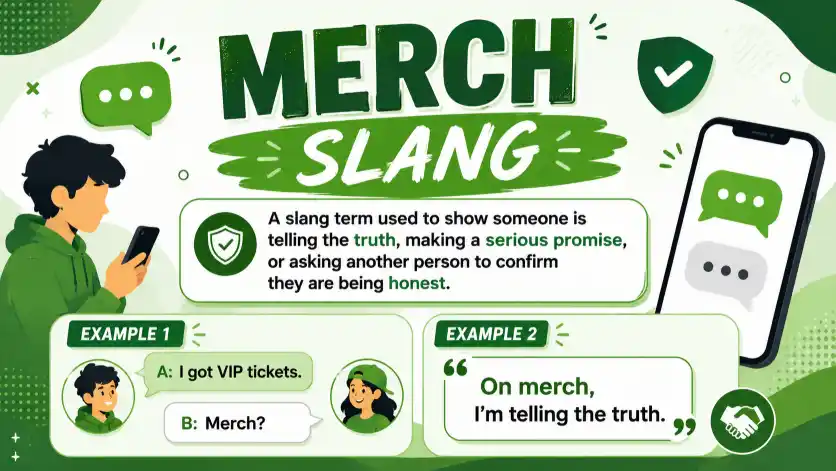
Merch slang means a way of saying someone is telling the truth or making a serious promise. It comes from the word “merchandise” but, in modern slang, “merch” is often used to show honesty, loyalty, or confidence in what someone is saying.
The term is common in texting, social media, music culture, and casual conversations.People search for merch slang because they see or hear words like “on merch,” “merch it,” or “that’s merch” on platforms such as TikTok, Instagram, and Reddit.
While the meaning can change slightly depending on the conversation, it usually signals that someone is being genuine or asking another person to swear that what they are are saying is true.
In this guide, you’ll learn what merch slang means, where it came from, how people use it, and when you should avoid using it.
Quick Answer: Merch Slang
Merch slang is an informal expression used to show that someone is serious, truthful, or willing to stand by what they said. Phrases like “on merch” or “merch it” are often used to ask for proof of honesty or to make a strong promise.
What Does Merch Slang Mean?
The meaning of merch slang depends on the situation, but it almost always relates to truthfulness or making a serious statement.
Someone might use it when they:
- Want others to believe them.
- Ask a friend to prove they are telling the truth.
- Emphasize that they are not joking.
- Show confidence in what they are saying.
Unlike many internet abbreviations, merch is a full word that has taken on a new slang meaning through everyday speech and online culture.
The Basic Meaning
In slang, merch means making a statement that carries weight. It is similar to saying:
- “I swear.”
- “I’m serious.”
- “Believe me.”
- “I’m not lying.”
For example:
Friend 1: “I met my favorite singer yesterday.”
Friend 2: “Merch?”
“On Merch” Meaning
The phrase “on merch” is one of the most common forms.
It means someone is putting their reputation or something important behind their statement.
Example:
- “On merch, I didn’t touch your phone.”
- “On merch, we’ll finish the project today.”
Here, the speaker wants others to trust them.
“Merch It” Meaning
Another popular phrase is “merch it.”
This means:
- Prove you’re telling the truth.
- Swear that your statement is real.
- Confirm your claim.
Example:
Alex: “I won free concert tickets.”
Jordan: “Merch it.”
Jordan wants Alex to promise that the story is true.
Full Form or Complete Meaning
Merch is not an abbreviation and does not have an official full form.
The word originally comes from “merchandise,” which usually means products or goods sold by a business, artist, sports team, or brand.
However, in modern slang, merch has developed a completely different meaning. Instead of referring to products, it is used to express honesty, seriousness, or a promise.
| Word | Standard Meaning | Slang Meaning |
| Merch | Merchandise or products | A serious promise, truth, or confirmation |
This difference is important because the intended meaning depends entirely on the conversation.
Different Meanings of Merch Slang
The word merch can have more than one meaning. Understanding the context helps you know which meaning the speaker intends.
Merch as a Promise
This is the most common slang meaning.
Someone uses merch to show they are being honest or making a serious promise.
Example:
- “Merch, I’ll be there before 7.”
Merch as a Truth Check
People also use merch to ask if someone is telling the truth.
Example:
- “You met the football team?”
- “Merch?”
In this case, the second speaker wants confirmation.
Merch as Merchandise
Outside slang, merch still keeps its original meaning.
It simply refers to products like:
- T-shirts
- Hoodies
- Hats
- Posters
- Mugs
Example:
- “I bought official concert merch.”
This is not slang. It refers to physical products.
Where Is Merch Slang Commonly Used?
Merch slang is mostly used in casual conversations rather than formal writing. It appears in online communities and everyday speech where people communicate quickly.
Text Messages
Friends often use merch to ask if someone is serious.
Example:
“Merch you passed the exam?”
TikTok
TikTok comments and videos sometimes include “on merch” to show confidence in a statement or challenge someone to be honest.
People may use it in captions, comments, or direct messages when reacting to surprising news.
Snapchat
Snapchat users often include merch in quick chats with close friends because the conversations are informal.
Some Reddit communities use merch when discussing stories that seem hard to believe, although the slang is less common there than on other platforms.
Music and Rap Culture
The slang gained much of its popularity through rap music and youth culture. In these communities, “on merch” is often used to make a statement sound more serious or believable.
Everyday Conversations
Many younger speakers use merch when talking face to face with friends.
Example:
- “On merch, that movie was amazing.”
- “Merch, I didn’t forget your birthday.”
Because slang changes over time, merch is still understood in many youth communities, but it may not be familiar to everyone, especially older audiences or people outside the culture where the expression became popular.
Is Merch Slang Rude, Offensive, or Harmless?
Merch slang is generally harmless. It is not considered rude or offensive by itself. Most people use it to show they are serious or to ask someone to confirm they are telling the truth.
However, the tone of the conversation matters. If you repeatedly challenge someone by saying “Merch?” it may sound like you do not trust them.
Is It Safe to Use?
Yes, in most casual conversations.
You can safely use merch slang when talking with:
- Friends
- Classmates
- Siblings
- Gaming teammates
- People you know well
Should You Use It at Work or School?
In professional or formal settings, it is better to avoid merch slang.
Instead, use clear and standard phrases such as:
- “Are you sure?”
- “Really?”
- “Can you confirm that?”
- “I promise.”
- “I’m telling the truth.”
Using standard English is usually a better choice when speaking with:
- Teachers
- Employers
- Clients
- Older family members
- Business contacts
| Situation | Is Merch Appropriate? |
| Texting friends | ✅ Yes |
| TikTok comments | ✅ Yes |
| Instagram DMs | ✅ Yes |
| Gaming chat | ✅ Yes |
| School presentation | ❌ No |
| Workplace email | ❌ No |
| Business meeting | ❌ No |
Real-Life Examples of Merch Slang
Seeing merch slang in real conversations makes it much easier to understand.
Friends Chatting
Emma: I finished the whole series in one day.
Liam: Merch?
Emma: On merch!
Text Message
Friend: I got front-row concert tickets.
You: Merch it.
Gaming Chat
Player 1: I got disconnected because my internet crashed.
Player 2: On merch, you didn’t quit?
TikTok Comment
On merch, this is the funniest video I’ve seen today.
Instagram DM
Alex: I saw our teacher at the airport.
Sam: Merch?
Family Conversation
Brother: Mom said we can order pizza tonight.
Sister: Merch?
Origin and History of Merch Slang
The slang meaning of merch is different from its original dictionary meaning.
Originally, merch was simply a shortened form of “merchandise.” People used it to talk about products sold by bands, artists, sports teams, and businesses.
How Did the Slang Meaning Develop?
Over time, the word gained a new meaning in parts of urban speech and hip-hop culture. Expressions like “on merch” began to mean that a person was standing behind their words and making a serious promise.
As social media grew, the slang spread through:
- Rap music
- Online videos
- TikTok
- Snapchat
- Group chats
Today, many younger users recognize merch as a way to express honesty rather than talking about products.
Is the Origin Certain?
The exact starting point of merch slang is not fully documented. Different communities have used the expression in slightly different ways over the years.
What is clear is that its slang meaning became popular through modern youth culture and online communication rather than from its original dictionary definition.
Similar Slang or Related Terms
Several slang expressions have a similar purpose to merch because they also show honesty or strong belief.
| Slang | Meaning | Similar to Merch? |
| No cap | I’m telling the truth | ✅ Yes |
| On God | I seriously mean it | ✅ Yes |
| For real | Honestly | ✅ Yes |
| Deadass | Completely serious | ✅ Yes |
| I swear | Promise | ✅ Yes |
Although these phrases are similar, each has its own cultural background and may be more common in certain communities.
When Should You Avoid Using Merch Slang?
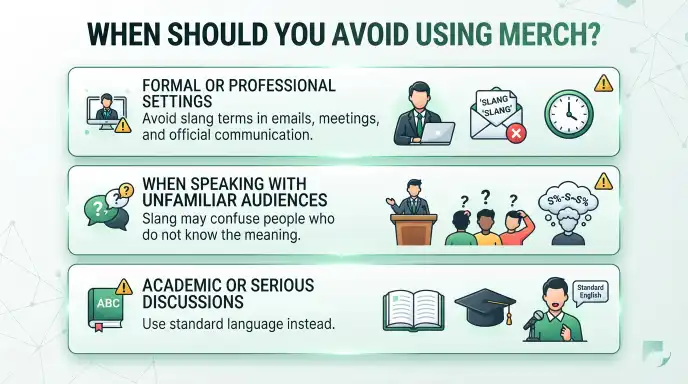
Even though merch slang is harmless, it is not suitable for every situation.
Avoid using it when:
- Writing school assignments
- Sending work emails
- Talking to customers
- Giving presentations
- Speaking during job interviews
- Communicating in other formal situations
It is also best to avoid using it if you are speaking with someone who may not understand internet slang. They could confuse merch with merchandise, leading to misunderstandings.
When in doubt, use plain English instead.
Polite Alternatives to Merch Slang
If you want to sound more professional or formal, these expressions work well.
| Instead of “Merch” | Say This |
| Merch? | Are you sure? |
| Merch it. | Can you confirm that? |
| On merch. | I promise. |
| Merch. | I’m serious. |
| On merch, I didn’t do it. | I honestly didn’t do it. |
These alternatives are easier for everyone to understand.
Why Do People Use Merch Slang?
People use merch slang because it is short, expressive, and easy to understand within casual conversations.
Some common reasons include:
To Show Honesty
It tells others that the speaker is being truthful.
To Ask for Proof
People say “Merch?” when they want someone to confirm a surprising claim.
To Fit Casual Conversations
The slang feels natural in texting, gaming, and social media where quick replies are common.
To Sound Natural Among Friends
Many people use merch simply because it is part of the language used in their friend group or online community.
To Add Emphasis
Saying “On merch” often sounds stronger than simply saying “I’m serious.” It adds confidence and emotion to the conversation.
Common Misunderstandings About Merch Slang
People often misunderstand merch slang because the word has both a standard English meaning and a slang meaning. Here are some of the most common misconceptions.
Merch Always Means Merchandise
This is the biggest misunderstanding. While merch often means merchandise (such as clothing or products), it can also be slang for being serious, honest, or asking someone to confirm the truth. The meaning depends on the context.
Merch Is an Abbreviation
No. Merch is not an abbreviation or acronym. It is simply a shortened form of merchandise that later developed a separate slang meaning.
Everyone Uses Merch the Same Way
Not always. Some people use “merch”, while others prefer phrases like “on merch” or “merch it.” Usage can vary between friend groups, regions, and online communities.
Merch Is Only Used Online
Although it is popular on social media and in text messages, many people also use merch slang in face-to-face conversations with friends.
Frequently Asked Questions
Q1. What does merch mean in slang?
Merch slang usually means someone is being truthful, making a serious promise, or asking another person to confirm that what they said is true.
Q2. What does “on merch” mean?
“On merch” means “I seriously mean it” or “I’m telling the truth.” It is often used to make a statement sound more believable.
Q3. Is merch slang offensive?
No. Merch slang is generally harmless and is not considered offensive. However, it is best used in casual conversations rather than formal settings.
Q4. Is merch short for merchandise?
Yes. In standard English, merch is short for merchandise. However, in slang, it has a different meaning related to honesty or making a serious statement.
Q5. Where is merch slang commonly used?
You may see merch slang on:
- TikTok
- Snapchat
- Discord
- Text messages
- Gaming chats
- Everyday conversations among friends
Q6. Can I use merch slang at work?
It is better not to. Professional settings usually require clear, formal language such as “I promise,” “I’m serious,” or “Can you confirm that?”
Q7. Is merch slang still popular?
Yes, merch slang is still used in many online communities and among younger speakers. However, its popularity can vary by region, age group, and social circle, as slang naturally changes over time.
Q8. What does merch it mean in slang on TikTok?
“Merch it” on TikTok means “prove you’re telling the truth” or “swear it’s real.” People use it to ask someone to confirm that a surprising story or claim is honest.
Q9. What does it mean when a Black person says merch?
In some African American Vernacular English (AAVE) and hip-hop culture, “merch” or “on merch” is used to show someone is being serious or telling the truth. The exact meaning can vary by region and community, so context is important.
Q10. What does merch mean in Gen Z?
For Gen Z, merch usually means being honest, making a serious promise, or asking someone to confirm they’re telling the truth. It’s commonly used in texting, TikTok, Snapchat, and casual conversations among friends.
Conclusion
Merch slang is a casual expression that usually means someone is telling the truth, making a serious promise, or asking another person to confirm a statement.
While the word originally comes from “merchandise,” its slang meaning has become popular through youth culture, hip-hop, texting, and social media.
The key to understanding merch slang is paying attention to the context. If someone says “on merch,” they are usually emphasizing honesty. If they say “merch?” they are asking if a statement is true.
Although the slang is common among friends and online communities, it is best avoided in formal situations like work, school presentations, or professional emails.
By understanding both meanings of merch, you’ll be able to recognize the term confidently if you see it in a text message, a TikTok comment, a gaming chat, or a real-life conversation.
Read More

Hi, I’m Rachel Simmons, a language writer specializing in American English and modern slang. I research regional expressions, everyday phrases, and evolving word meanings across the United States. I enjoy making complex language trends simple, practical, and easy for everyone to understand.