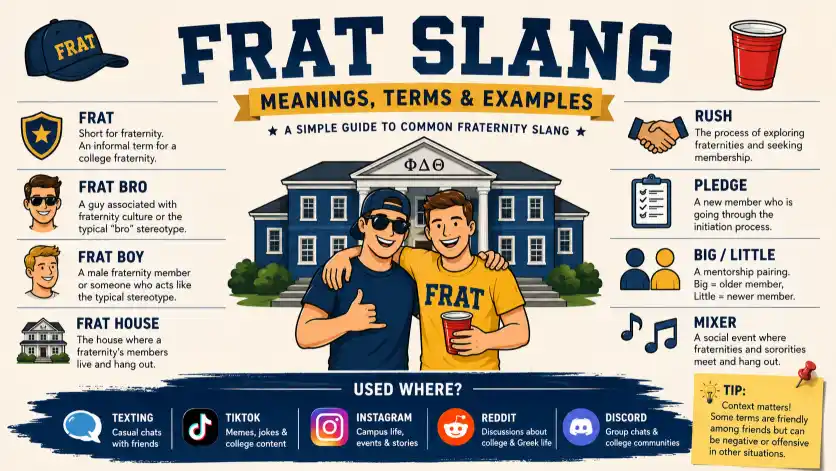
Frat slang refers to informal words and phrases linked to fraternity life, college social groups, and Greek culture.
The word “frat” itself is a casual short form of “fraternity,” but the wider term can include expressions used for fraternity members, parties, recruitment, friendships, and campus life.
If you searched for frat slang, you may have seen terms such as frat bro, frat boy, frat house, rush, pledge, Big, Little, or Greek life and wondered what they mean.
Some of these terms describe real parts of fraternity life, while others are used online to describe stereotypes or college culture.
This guide explains frat slang in simple English. You will learn what the main terms mean, where they are used, if they are rude, and how their meaning can change depending on context.
Quick Answer: What Does Frat Slang Mean?
Frat slang is informal language associated with fraternities, fraternity members, and college Greek life. It includes words such as frat, frat bro, frat boy, frat house, rush, pledge, Big, Little, and mixer.
The exact slang can vary from one college, fraternity, or social group to another.
What Does “Frat” Mean in Slang?
“Frat” is an informal short form of “fraternity.” In American college culture, it usually refers to a fraternity or, in some contexts, the social culture connected with fraternities.
For example:
“He’s thinking about joining a frat.”
Here, frat simply means fraternity.
The word itself does not automatically mean partying, drinking, or bad behavior. Those ideas are connected to stereotypes about some aspects of fraternity culture, not the basic definition of the word.
Frat vs. fraternity
| Word | Meaning | Tone |
| Frat | Short form of fraternity | Informal |
| Fraternity | A college organization | Neutral/formal |
| Frat boy | A male fraternity member or someone fitting a frat stereotype | Informal |
| Frat bro | A male associated with frat culture or its stereotype | Informal |
If you are writing an academic paper or formal email, fraternity is usually the better choice.
Common Frat Slang Terms
There is no single official list of frat slang used by every fraternity. Some terms are widely understood across U.S. college culture, while others may be specific to a campus or organization.
Frat Bro
Frat bro is an informal term for a male associated with fraternity culture.
It can refer to an actual fraternity member, but it can also describe someone who appears to fit a common stereotype of a fraternity guy.
The tone depends heavily on context.
Example:
“He has a big frat-bro personality.”
This could be playful or slightly critical depending on the speaker.
Frat Boy
Frat boy can mean a male fraternity member. However, people also use it to describe someone who fits a stereotypical image of fraternity culture.
That image may involve being very social, confident, competitive, or party-focused.
Not every fraternity member fits this stereotype.
Example:
“He looks like a frat boy, but he’s actually pretty quiet.”
Frat House
A frat house is a house or residence associated with a fraternity.
Depending on the college and organization, members may live there or use the property for fraternity activities and social events.
Example:
“They’re having a meeting at the frat house.”
Rush
Rush is a common term for the fraternity recruitment process.
A student may say:
“I’m rushing this semester.”
This generally means the student is taking part in activities where they can learn about fraternities and potentially join one.
Recruitment systems and terminology can differ between colleges and organizations.
Pledge
A pledge traditionally refers to someone who has been accepted into a fraternity but has not yet become a full member.
The term is connected with the membership process, although the exact process and terminology can vary.
Example:
“His roommate is a pledge this semester.”
Brother
Members of a fraternity commonly call one another brothers.
This does not mean they are biological brothers. It refers to their membership in the same fraternity and the sense of connection within the group.
Example:
“He’s one of my fraternity brothers.”
Big and Little
Big and Little are terms used in some Greek organizations for a mentoring relationship.
A more experienced member may be called a Big, while a newer member may be called a Little.
The traditions surrounding these roles can vary between organizations.
Example:
“She found out who her Big is this week.”
Greek Life
Greek life is a broader term for fraternity and sorority life on a college campus.
It includes both fraternities and sororities, so it is broader than the word frat.
Example:
“Greek life is active on our campus.”
Mixer
A mixer is a social event involving members of different Greek organizations.
For example, a fraternity and sorority may hold a joint social event.
Example:
“Our fraternity has a mixer with another Greek organization on Friday.”
Frat Slang vs. Frat Culture
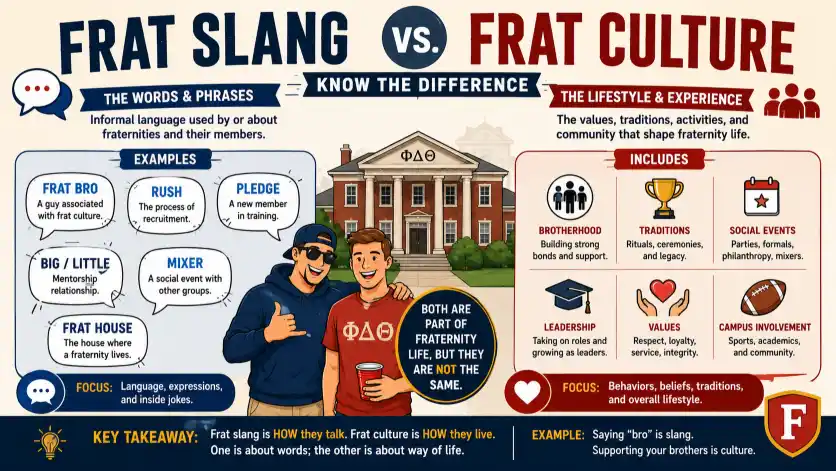
Both Frat slang and frat culture are related, but they do not mean the same thing.
Frat slang refers to words and expressions associated with fraternity life.
Frat culture is much broader. It can include social traditions, campus activities, parties, clothing, sports, music, group behavior, and other parts of fraternity life.
Someone can use a term associated with frat culture without belonging to a fraternity.
For example, a person on TikTok might call someone a “frat bro” simply because that person appears to fit a certain college stereotype.
That does not necessarily mean the person is actually a fraternity member.
Where Is Frat Slang Commonly Used?
Frat slang is most common in U.S. college settings, but some terms have spread into social media and everyday conversations.
College campuses
College campuses are the main setting for these terms.
Students may talk about:
- joining a frat
- rushing
- fraternity brothers
- pledges
- frat houses
- mixers
- Greek life
Text messages and group chats
Friends may use frat slang when discussing parties, recruitment, campus events, or fraternity members.
Is Frat Slang Rude or Offensive?
Most frat slang is not automatically rude or offensive, but some terms can become negative when they are used as stereotypes.
The word frat itself is normally just an informal abbreviation of fraternity.
The tone changes with terms such as frat boy or frat bro.
For example:
“I’m a frat bro.”
A person might use this jokingly about themselves.
But:
“He’s just another foolish frat bro.”
This is clearly more insulting because the speaker is using the phrase to judge the person’s personality.
Why context matters
The same term can be:
- friendly
- neutral
- humorous
- teasing
- dismissive
- insulting
So it is better to look at the speaker, situation, and tone instead of assuming that every frat-related slang word is offensive.
Why Do People Use Frat Slang?
People use frat slang for several reasons.
To show group identity
Shared language can help members feel connected to a group.
Fraternity communities may develop expressions that are familiar to members but less familiar to outsiders.
To sound casual
Slang usually feels less formal than standard language.
Saying:
“I joined a frat.”
sounds more casual than:
“I joined a fraternity.”
To describe a stereotype
On social media, people may use terms such as frat bro to describe a certain style or personality.
The person using the term may not be talking about actual fraternity membership.
To create inside jokes
College groups often develop their own phrases, jokes, and references. Some can remain within one fraternity or campus.
Real-Life Frat Slang Examples
Talking about membership
Alex: “Are you in a frat?”
Jordan: “Yeah, I joined one last year.”
Here, frat simply means fraternity.
Talking about recruitment
Alex: “Are you rushing this semester?”
Jordan: “Maybe. I’m checking out a few houses first.”
Here, rushing refers to the recruitment process.
Talking about a fraternity house
Alex: “Where is everyone?”
Jordan: “They’re at the frat house.”
Here, frat house means a house or location associated with a fraternity.
Describing a stereotype
Alex: “That guy has a serious frat-bro vibe.”
Jordan: “Yeah, but I don’t know if he’s actually in a fraternity.”
Here, frat bro is being used as a description rather than proof of membership.
Origin and History of “Frat”
The word “frat” is much older than modern Gen Z slang.
It developed as an informal shortening of fraternity and has been used in American English since the late 19th century.
Merriam-Webster lists its first known use around 1895, while other major dictionary sources place its origin around 1890–95.
This is important because “frat” should not be described as a word invented by Gen Z or social media.
The wider vocabulary connected with fraternity culture is different. Individual expressions can appear, spread, change, or disappear over time.
There is therefore no single origin date for “frat slang” as a whole.
Where did modern frat slang develop?
Modern fraternity slang has developed through a mix of:
- college campus culture
- individual fraternity traditions
- student social groups
- regional speech
- popular culture
- social media
Some expressions can be widely understood, while others may be limited to a particular fraternity or campus.
Is Frat Slang Still Popular?
Yes, many basic fraternity terms remain easy to understand, but individual slang expressions can change quickly.
Words such as frat, fraternity brother, frat house, rush, pledge, and Greek life remain useful because they describe recognizable parts of college culture.
However, some expressions may sound dated, exaggerated, or stereotypical depending on the speaker and audience.
This is especially true online, where terms such as frat boy or frat bro can be used more as cultural labels than literal descriptions of fraternity membership.
How Frat Slang Changes by Context
Frat slang does not have one fixed meaning everywhere. A word can sound friendly among college friends but negative when someone uses it to stereotype another person.
For example, “frat bro” can be a simple description in one conversation and an insult in another.
The safest way to understand frat slang is to look at who is speaking, who they are talking about, and the tone of the conversation.
Friendly use
A fraternity member may casually describe himself or a friend as a frat bro.
Example:
“We’re basically a bunch of frat bros hanging out after class.”
Here, the phrase is being used casually and may not be insulting.
Negative use
Someone outside Greek life might use the same term to criticize a person’s behavior.
Example:
“He acts like a typical frat bro.”
In this case, the speaker may be referring to a stereotype rather than actual fraternity membership.
Frat Slang on Different Platforms
The meaning and tone of frat slang can change depending on where you see it.
Texting
In text messages, fraternity slang is usually short and casual.
Example:
“Which frat are you going to tonight?”
The person may simply be asking about a fraternity event or house.
TikTok
On TikTok, words such as frat boy and frat bro can be used in jokes, memes, videos, or stereotype-based content.
The term may describe someone’s appearance, behavior, clothing, or general college persona rather than their actual membership.
Instagram posts may use frat-related language when discussing:
- college events
- campus life
- fraternity activities
- social gatherings
- college fashion
- Greek organizations
The tone is usually casual.
Reddit can be more discussion-focused. Users may talk about fraternity recruitment, college experiences, Greek life, or the stereotypes connected with fraternities.
Because Reddit communities have different cultures, a term such as frat bro can be humorous in one discussion and strongly negative in another.
Discord
Frat slang may appear in private servers where college friends talk about social plans or campus life.
It is not specifically Discord slang. The platform simply provides another place where college-related language can appear.
Workplace chat
Frat slang is usually unnecessary in workplace communication.
If a fraternity is relevant to a professional conversation, fraternity is normally clearer and more formal than frat.
Is “Frat” Appropriate at School or Work?
“Frat” is acceptable in casual conversation, but “fraternity” is usually better for formal or academic communication.
With friends
Using frat is generally fine when talking casually with friends.
“My friend joined a frat.”
With a teacher or professor
You can use the word in casual conversation, but fraternity may sound more polished in an academic setting.
Instead of:
“He joined a frat.”
A formal sentence could be:
“He joined a fraternity.”
In a school assignment
Use fraternity when writing an essay, report, or research paper unless you are discussing the word frat itself.
At work
In professional writing, choose fraternity unless the informal wording is part of a quote or is important to the subject.
When Should You Avoid Using Frat Slang?
You should avoid or limit frat slang when the term could create confusion, sound disrespectful, or stereotype someone.
Avoid it in formal writing
Use fraternity instead of frat in most formal academic and professional writing.
Avoid labeling people without evidence
Calling someone a frat bro does not prove that they belong to a fraternity.
A person may simply have a style or personality that someone associates with a fraternity stereotype.
Be careful with “frat boy”
Frat boy can be descriptive, but it can also carry negative assumptions.
If you do not know if someone belongs to a fraternity, it may be better to describe the specific behavior instead.
For example, instead of:
“He’s such a frat boy.”
You could say:
“He’s very loud and social.”
The second statement describes an observable behavior instead of assigning a stereotype.
Avoid using insider terms when you do not know their meaning
Some fraternity expressions can be specific to an organization or campus.
Using a term incorrectly can make the conversation confusing.
Polite Alternatives to Frat Slang
If you want to sound more neutral, use these alternatives:
| Casual term | More neutral alternative |
| Frat | Fraternity |
| Frat bro | Fraternity member |
| Frat boy | Fraternity member |
| Frat house | Fraternity house |
| Greek life | Fraternity and sorority life |
| Brother | Fraternity member |
These alternatives are especially useful in school, journalism, workplace communication, and other formal settings.
Common Misunderstandings About Frat Slang
“Frat” means party
Not exactly.
Frat is simply an informal short form of fraternity. It does not automatically mean a party or a particular lifestyle.
The party-related meaning comes from broader ideas about fraternity culture.
Every frat member is a frat bro
No.
Frat bro is often used as a stereotype. Not every fraternity member behaves in the way associated with that stereotype.
Frat slang is only used by fraternity members
No.
People outside fraternities can use fraternity-related terms when talking about college culture, social media, movies, or stereotypes.
Frat slang is the same at every college
No.
Some terms are widely understood, while others may be specific to a fraternity, campus, region, or social group.
“Greek life” only means fraternities
No.
Greek life normally refers to both fraternities and sororities.
Frat Slang vs. Related College Terms
Understanding the difference between common terms makes college conversations easier to follow.
| Term | Meaning |
| Frat | Informal term for fraternity |
| Fraternity | A college organization |
| Frat bro | Informal label for a male associated with frat culture |
| Frat boy | Male fraternity member or someone fitting a frat stereotype |
| Frat house | House associated with a fraternity |
| Rush | Fraternity recruitment process |
| Pledge | New member in certain fraternity membership systems |
| Brother | Member of the same fraternity |
| Big | More experienced member in a Big/Little relationship |
| Little | Newer member in a Big/Little relationship |
| Mixer | Social event involving Greek organizations |
| Greek life | Broader fraternity and sorority culture |
Why Do People Say “Frat Bro”?
People often say “frat bro” because it quickly communicates a particular social image or stereotype.
The phrase combines frat, meaning fraternity, with bro, an informal word for a male friend or person associated with a “bro” style of behavior.
The term can be used in two main ways.
Literal or group-related use
It may describe someone who is actually involved in fraternity life.
Example:
“He’s a frat bro at the university.”
Stereotype-based use
It can describe someone who appears to fit a stereotypical fraternity persona.
Example:
“That movie character is written as a frat bro.”
The second use does not necessarily mean the character belongs to a real fraternity.
Is Frat Slang Used Outside College?
Yes. Some fraternity-related slang has moved beyond college settings, especially through movies, television, social media, and internet culture.
Words such as frat boy and frat bro can be used to describe a type of personality even when the person being discussed is not currently in college.
For example:
“The character has a frat-bro personality.”
Here, the phrase describes a cultural stereotype rather than an actual student organization.
This wider use is one reason you may encounter frat slang on social media even when the conversation has nothing to do with joining a fraternity.
Does Frat Slang Have a Specific Age Group?
There is no single age group that uses all frat slang.
The terms are most strongly connected with college-age people and people familiar with U.S. college culture. However, older adults, parents, writers, journalists, and social media users may also recognize or use them.
Some terms are simply common English words now.
For example, someone does not need to be a college student to understand frat house.
What changes more is the tone. Younger users may use terms such as frat bro jokingly online, while an older speaker may use fraternity member instead.
Does “Frat” Mean the Same Thing as “Brotherhood”?
No.
A fraternity may emphasize brotherhood among its members, but frat itself simply refers to the fraternity.
For example:
“He joined a frat.”
means:
“He joined a fraternity.”
It does not literally mean that he joined a “brotherhood.”
Similarly, when fraternity members call one another brothers, the term refers to their group relationship.
Is Frat Slang American?
The word “frat” is strongly associated with American English and U.S. college culture.
Fraternities also exist in other countries, but the specific slang and traditions surrounding American fraternities may not transfer directly.
If you see frat in a social media post, college discussion, or meme, the U.S. college meaning is usually the most likely interpretation.
Context can still matter, especially if the conversation is about another country or a different type of organization.
Frequently Asked Questions
Q1. What does frat slang mean?
Frat slang means informal words and phrases associated with fraternity life, college social groups, and Greek culture. Common examples include frat, frat bro, frat boy, rush, pledge, frat house, Big, Little, and mixer.
Q2. What does “frat” stand for?
Frat is an informal shortened form of fraternity. It is commonly used in American college conversations.
Q3. What does “frat bro” mean?
Frat bro is an informal term for a male associated with fraternity culture. It can describe an actual fraternity member or someone who fits a common stereotype of a fraternity guy.
Q4. What does “frat boy” mean?
Frat boy can mean a male fraternity member. It is also commonly used as a stereotype for someone seen as having a typical fraternity-style personality or lifestyle.
Q5. Is “frat” a bad word?
No. Frat is generally an informal word, not a swear word. However, phrases such as frat boy or frat bro can sound negative when used to stereotype or insult someone.
Q6. What is the difference between frat and Greek life?
Frat normally refers to a fraternity, while Greek life is a broader term covering both fraternities and sororities.
Q7. What does “rush” mean in frat slang?
Rush usually refers to the process through which students explore fraternities and potentially seek membership. The exact process can vary between colleges and organizations.
Q8. What does “pledge” mean in fraternity slang?
A pledge traditionally refers to a person who has been accepted into a fraternity but has not yet become a full member. Terminology and membership practices can vary.
Conclusion
Frat slang is the informal vocabulary connected with fraternity life and U.S. college culture. The most important term is frat, which is simply a casual shortening of fraternity.
Other expressions, such as frat bro, frat boy, frat house, rush, pledge, Big, Little, and mixer, describe different parts of fraternity culture or the way people talk about it.
The key is context. Some terms are neutral within a college group but can sound mocking when used to stereotype someone. For formal school or workplace communication, words such as fraternity and fraternity member are usually safer and clearer.
If you understand the setting and the speaker’s tone, you can usually tell if frat slang is being used literally, casually, humorously, or negatively.
Discover Related Slang Terms:
- What Is Wodie in Texting? Examples, and Social Media Uses
- CF Slang Meaning: Examples Across Social Media and Texting
- Jhit Slang Meaning: Definition, Origin & Examples

Hi, I’m Rachel Simmons, a language writer specializing in American English and modern slang. I research regional expressions, everyday phrases, and evolving word meanings across the United States. I enjoy making complex language trends simple, practical, and easy for everyone to understand.