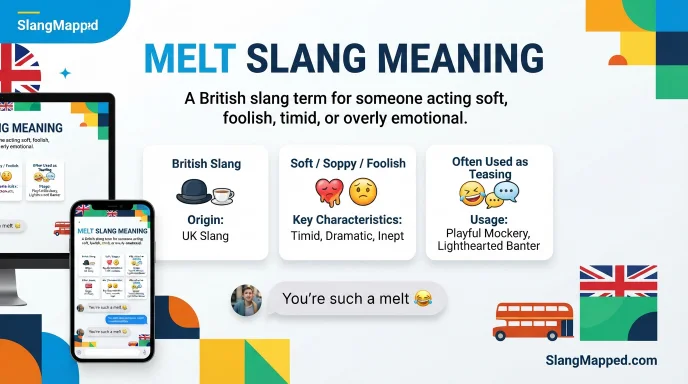
The melt slang meaning is usually connected to someone who is acting soft, foolish, overly emotional, or a little pathetic.
In British slang, calling someone “a melt” can be a teasing way to say they are being weak or silly. In romantic situations, it can also mean someone who has become very soppy because they have strong feelings for another person.
You may see “melt” in British conversations, texts, social media comments, or reality-TV discussions. The term became especially familiar to wider audiences through Love Island, where it was used for someone acting overly emotional or foolish over a romantic interest.
The tricky part is that “melt” does not always have the same strength. Among friends, it can sound funny and harmless. Said aggressively to a stranger, it can be a genuine insult. The context and tone matter.
Quick Answer Table
| Question | Answer |
| Meaning | A soft, foolish, weak, or overly emotional person |
| Tone | Usually teasing, but it can be insulting |
| Used by | Mainly British English speakers; also seen online |
| Common platforms | Texting, TikTok, Instagram, Reddit, WhatsApp, and other social spaces |
| Offensive? | Usually mild, but it can offend someone depending on tone |
| Pronunciation | “melt,” rhyming with “felt” |
| Romantic meaning | Someone who becomes very soppy because they like someone |
The important detail is that “melt” is not always about being generally weak. In some contexts, it specifically points to someone who has gone soft because of their emotions, especially romantic feelings. That is why you may see phrases such as “you’re such a melt” or “I’m being a proper melt over her.”
What Does “Melt” Mean in Slang?
In slang, “melt” usually means a person who is soft, weak, overly emotional, foolish, or acting a little pathetic. It is especially common in British slang and can be playful or insulting depending on the situation. In dating contexts, a “melt” can describe someone who has become very soppy because they like someone.
It can describe a person who:
- Gets emotional very easily
- Acts weak or timid
- Is being silly or foolish
- Becomes overly romantic
- Acts pathetic over a small issue
- Loses their confidence because of their feelings
For example:
“Mate, you’re such a melt.”
This could mean:
“You’re being really soft or silly.”
The exact meaning depends on what happened. If someone is crying over a romantic situation, “melt” may focus on being overly emotional. If someone is afraid to do something simple, it may suggest they are being weak or timid.
Collins Dictionary also records “melt” as slang for a meek, submissive, or timid person, supporting this broader British slang sense.
Melt Slang Meaning in British English
The word is strongly associated with British slang.
A British speaker might call someone a “melt” when that person is being:
- Soft
- Soppy
- Timid
- Foolish
- Overly sensitive
- Too emotional
For example:
“He won’t ask her out because he’s nervous. What a melt.”
Here, “melt” means the person is acting too timid or lacking confidence.
The word can also be used between friends as casual banter. It does not automatically mean the speaker seriously dislikes the person.
“Melt” Meaning in Romantic Situations
Romantic situations give the word a slightly different flavor.
Someone may be called a melt when they become extremely soft or soppy around someone they like. This meaning became particularly recognizable through Love Island terminology. Contemporary explanations of the show’s slang described a melt as someone acting soppy toward their crush or becoming foolish because of romantic feelings.
For example:
“I can’t believe I’m sending her flowers every week. I’m such a melt.”
The speaker is joking that their romantic feelings have made them unusually soft.
So, in this context, melt ≈ softie + lovestruck fool.
Pronunciation of “Melt”
Melt is pronounced exactly like the normal English word:
/melt/
It rhymes with:
- Felt
- Belt
- Pelt
- Smelt
There is no special slang pronunciation.
Where Is “Melt” Used?
The slang meaning is mainly associated with British English, but people outside the UK can encounter it through British media and online content.
| Platform | How “Melt” May Appear | Example |
| TikTok | Jokes about someone acting soft or foolish | “Bro is such a melt ” |
| Comments about someone’s romantic behavior | “You two have made him a melt.” | |
| British-style comments and discussions | “Don’t be a melt.” | |
| Casual banter between friends | “Stop being a melt and come out.” | |
| Discord | Informal teasing in group chats | “You’re a proper melt ” |
| Reality TV discussions | Romantic or emotional behavior | “He’s acting like a melt over her.” |
These uses should not be treated as proof that the word has a special meaning on every platform. The core slang meaning stays fairly stable; the situation changes the shade of meaning.
What Does “You Melt” Mean?
“You melt” is a direct way of calling someone a melt.
For example:
“You forgot your umbrella again. You melt.”
Depending on the tone, this could be friendly teasing.
Another example:
“You cried during that movie? You melt!”
Here, the speaker is teasing someone for being emotional.
It can sound much harsher if said during an argument, so tone matters.
What Does “Proper Melt” Mean?
In British informal speech, “proper” can work as an intensifier, meaning “really” or “very.”
So:
“proper melt” = really soft, foolish, or pathetic person
Example:
“He apologized five times after one tiny argument. Proper melt.”
This is stronger than simply calling someone “a melt,” but it can still be playful.
Is “Melt” an Insult?
Yes, it can be an insult, but it is often a mild one.
Calling someone a melt suggests that they are behaving in a way the speaker considers weak, silly, soft, or overly emotional.
The relationship matters:
- Close friend: Often playful
- Family member: Usually teasing
- Stranger: More likely to sound insulting
- Argument: Can sound harsh
- Romantic joke: Often lighthearted
If you are unsure about the relationship or tone, it is safer not to use it.
Is “Melt” Positive or Negative?
The slang is usually negative, but it does not always carry serious hostility.
A friend might say:
“You’re such a melt ”
and mean:
“You’re being ridiculous, but I’m joking.”
Someone angry might say:
“You’re an absolute melt.”
That version is much more clearly insulting.
So the best description is mildly negative and highly context-dependent.
Melt vs. Softie vs. Fool
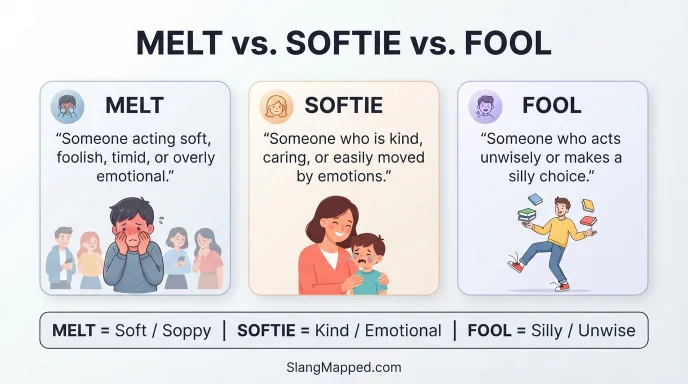
These words overlap, but they are not identical.
| Word | Main Idea | Typical Tone |
| Melt | Someone acting soft, foolish, or overly emotional | Teasing to insulting |
| Softie | Someone who is kind or easily emotional | Often affectionate |
| Fool | Someone who has acted unwisely | Mild to negative |
| Soppy | Someone showing too much emotion or romance | Usually teasing |
| Wimp | Someone seen as lacking courage | More negative |
Melt sits somewhere between softie, soppy person, and fool, depending on context.
Melt Slang vs. “Meltdown”
Do not confuse a melt with a meltdown.
A melt is generally a person.
A meltdown is an intense emotional reaction or loss of control.
For example:
“He’s such a melt.”
This describes the person.
But:
“He had a meltdown.”
This describes what happened.
The words are related in everyday imagery, but they are not interchangeable.
Is “Melt” Still Used?
Yes, “melt” remains recognizable as British slang, although its familiarity varies by region, age, and context.
It also became more widely recognizable outside traditional British slang through Love Island and online discussion of British expressions. A 2017 YouGov survey found that only 14% of British respondents understood the Love Island slang sense of “melt,” showing that even within Britain the term was not universally understood.
That does not mean the word disappeared. It means slang familiarity can vary greatly even among speakers of the same language.
Melt Slang Examples in Real Conversations
Text Message
Callum: “Are you really not coming because it’s raining?”
Lewis: “Yeah, don’t want to get wet.”
Callum: “You’re such a melt ”
Here, “melt” means someone being soft or overly cautious.
Romantic Situation
Maya: “He wrote her a three-page message.”
Sophie: “No way. He’s become a proper melt.”
The speaker is teasing him for becoming very emotional or soppy because of romance.
TikTok Comment
“Bro got one compliment and turned into a melt ”
This uses the word humorously to suggest that someone became soft or overly emotional after receiving attention.
Discord Chat
Jordan: “I don’t want to play because everyone will laugh if I lose.”
Marcus: “Stop being a melt and queue up.”
Here, the word means someone who is being timid or lacking confidence.
Everyday Conversation
Aiden: “I can’t eat the last slice. You can have it.”
Noah: “You’re too nice. Absolute melt.”
This example is more playful. The speaker is teasing someone for being soft-hearted rather than seriously insulting them.
Common Mistakes With “Melt”
1. Thinking It Always Means “Idiot”
“Melt” can describe a foolish person, but idiot is not its only meaning.
It can also suggest someone is soft, timid, soppy, or overly emotional.
2. Assuming It Is Always Offensive
The word can be insulting, but friends often use it as playful banter.
Tone is important.
3. Using It Like “Melting”
“Melt” as slang is usually a noun describing a person:
“He’s a melt.”
That is different from the normal verb:
“The ice is melting.”
4. Assuming It Is American Slang
The slang sense is strongly associated with British English. American readers may understand it from British media or online content, but it is not a standard everyday American slang term in the same way.
5. Thinking “Melt” Only Relates to Dating
Dating is an important context, especially because of Love Island, but the word can also describe someone who is simply acting soft, timid, foolish, or overly emotional.
Key Takeaways
- Melt is British slang for someone acting soft, foolish, timid, or overly emotional.
- It can describe someone who has become soppy because of a crush.
- The term is usually mildly negative but can be friendly teasing.
- “You melt” and “proper melt” are common variations.
- Context and tone determine if it sounds funny or insulting.
- The slang is especially associated with British English and has been popularized to wider audiences through British reality TV and online culture.
FAQs About Melt Slang Meaning
Q1. What does “melt” mean in British slang?
In British slang, a “melt” is usually someone who is soft, timid, foolish, or overly emotional. It can be used as a mild insult or friendly teasing. In romantic situations, it may describe someone who has become very soppy because they like another person.
Q2. Is calling someone a “melt” rude?
It can be rude, but it is often fairly mild. Friends may use “melt” as playful banter when someone is acting silly or emotional. However, saying “you absolute melt” during an argument can sound insulting. Your relationship with the person and your tone make a big difference.
Q3. What does “you melt” mean?
“You melt” is a direct way to call someone a melt. It usually means “you are being soft, silly, timid, or overly emotional.” Friends may say it jokingly after someone does something embarrassing or sentimental. The phrase can become more insulting when used aggressively.
Q4. What does “melt” mean on Love Island?
On Love Island, “melt” has been used for someone who acts soppy or overly emotional toward a romantic interest. It can suggest that a person has become soft or foolish because they really like someone. The show helped make this slang sense familiar to a much wider audience.
Q5. Is “melt” a British word?
The slang sense is strongly associated with British English. Collins lists “melt” as slang for a meek, submissive, or timid person. British speakers may use it in everyday banter, while people elsewhere may recognize it through British television, social media, or online conversations.
Q6. What is another word for “melt” in slang?
Depending on context, similar words include softie, soppy, wimp, fool, idiot, and soft. None is an exact replacement in every situation. “Softie” can sound affectionate, while “wimp” is usually more negative. “Melt” often combines the ideas of being soft and a little foolish.
Q7. Can “melt” be used for a woman?
Yes. “Melt” can describe anyone. The slang is not limited to men. A speaker might call a woman a melt if she is acting overly emotional, soft, silly, or soppy. As with any informal insult, the tone determines if the comment feels playful or disrespectful.
Q8. Does “melt” have a normal meaning too?
Yes. Outside slang, melt commonly means to become liquid because of heat, such as ice melting. It can also refer to a food item such as a sandwich containing melted cheese. The slang meaning is separate and depends on context.
Conclusion
The melt slang meaning is easiest to understand as a person who is acting soft, foolish, timid, or overly emotional. In British English, it is often used as casual banter. In romantic situations, it can describe someone who has become especially soppy because they like someone.
The word does not have to be seriously offensive. Friends may throw it around as a joke, while the same word can sound insulting during an argument. That makes context especially important.
You may also see “you melt,” “proper melt,” or “total melt.” These phrases generally keep the same basic idea but can make the insult stronger.
If you are learning British slang, understanding this difference between the literal word and its slang meaning can help you read texts, social media comments, and British entertainment more naturally.
Discover More Articles:
- Silver Fox Slang: Meaning and Celebrity Culture
- What Does Fresh Slang Mean? Here’s the Answer
- Pot Meaning Slang: Definition, Usage, and Examples

Hi, I’m Rachel Simmons, a language writer specializing in American English and modern slang. I research regional expressions, everyday phrases, and evolving word meanings across the United States. I enjoy making complex language trends simple, practical, and easy for everyone to understand.