Chomo slang is a derogatory term short for “child molester,” often used in U.S. prison culture and in discussions related to crimes involving children.
Unlike many popular internet abbreviations, this word carries a serious and offensive meaning, so it’s important to understand its context before using or encountering it in a text, comment, or social media post.
The term is believed to have originated within the U.S. prison system, where it’s used as a slur against individuals convicted of child-related sex offenses.
Over time, it has also spread beyond prison walls into broader slang, sometimes appearing in online discussions, true crime content, or social commentary.
Because of its serious nature, “chomo” is not casual slang, it’s typically used in specific, negative contexts rather than everyday conversation.
Understanding where and how the term is used can help clarify its meaning when you come across it, and why it’s important to use such language carefully and responsibly.
Quick Answer
Chomo slang means “child molester.” It is highly offensive slang associated with U.S. prison culture and is also used online as an accusation, insult, or reference to someone accused or convicted of sexual abuse involving a child.
What Does Chomo Mean in Text?
When someone uses chomo in a text message, comment, or online conversation, they are usually referring to a child molester.
The term has a strongly negative tone. It is not normally used as friendly slang or as a neutral description.
For example:
“People in the comments are calling him a chomo.”
This means that people in the comments are accusing or labeling the person as a child molester. However, the sentence itself does not prove that the accusation is true.
This distinction is important because people sometimes use serious terms during online arguments without evidence.
Chomo Meaning in Different Contexts
The meaning can remain basically the same while the purpose changes.
Someone might use the word to:
- Describe a convicted offender
- Discuss prison culture
- Repeat an online accusation
- Insult someone during an argument
- Discuss a criminal case
- React to allegedly inappropriate behavior
Therefore, always consider the surrounding conversation before interpreting the exact intent.
Chomo Full Form and Definition
The commonly understood chomo full form is child molester.
The term is generally treated as slang rather than a formal acronym. Its documented etymology is commonly explained as a blend involving “child” and “molester.”
| Term | Meaning |
| Chomo | Child molester |
| Chomos | Plural form of chomo |
| Chomo slang | Offensive slang referring to a child molester |
| Chomo meaning in text | Usually a reference to a child molester or an accusation that someone is one |
It is important not to confuse a slang meaning with a legal definition. Chomo is not a formal criminal charge or official legal classification.
What Does Chomo Stand For?
If someone asks, “What does chomo stand for?”, the simple answer is child molester.
However, it is more accurate to describe it as slang than as a traditional abbreviation.
Is Chomo Rude, Offensive, or Neutral?
Chomo is highly offensive and derogatory.
The word refers to a very serious type of criminal behavior, so it carries much stronger emotional weight than ordinary slang.
It may communicate:
- Anger
- Disgust
- Hostility
- Accusation
- Condemnation
- Reference to criminal behavior
It should not normally be used casually.
Why Is Chomo Considered Offensive?
The word is offensive because it labels a person with a highly serious accusation.
Even when someone uses it jokingly, the underlying meaning does not become harmless. In many situations, the word can damage someone’s reputation if it is used without factual support.
For formal or responsible communication, factual language is usually better.
Where Is Chomo Commonly Used?
Chomo is strongly associated with U.S. prison slang.
The term has also appeared outside prison settings as internet communities have adopted slang from prison culture and other subcultures.
You may encounter it in:
- Reddit discussions
- TikTok comments
- YouTube comments
- Social media arguments
- Online forums
- Text messages
- True-crime discussions
- Prison-related content
- Online communities
It is not equally common on every platform, and many users may never encounter the term.
Chomo on Social Media
On social media, people sometimes use the word when discussing allegations involving inappropriate behavior toward children.
However, social media comments can contain rumors, exaggerations, or unsupported claims. Seeing someone called a “chomo” does not establish that the person actually committed a crime.
Chomo in Prison-Related Discussions
The term has a particularly strong connection to prison vocabulary.
In discussions about prison culture, it may be used to identify or stigmatize inmates convicted of offenses involving children.
Real-Life Examples of Chomo Slang
Because chomo refers to a serious subject, these examples are designed to explain usage rather than make accusations about real people.
Casual Online Example
“I saw people calling him a chomo in the comments.”
Here, the speaker is reporting what other people are saying.
Argumentative Example
“Don’t call someone a chomo without proof.”
In this example, the word is being discussed as a serious accusation.
Social Media Example
“The post caused a debate after users accused the creator of being a chomo.”
This describes an allegation without presenting it as an established fact.
Prison-Related Example
“The documentary explained the meaning of chomo in prison slang.”
Here, the term is being discussed as part of prison vocabulary.
Gaming or Community Chat Example
“Why is everyone using the word chomo in this server?”
This shows how the term might appear in an online community, even though using it as a casual insult is inappropriate.
Friendly Context
There is no genuinely friendly meaning of “chomo” when it is being used with its common slang definition.
Someone may use the word jokingly with friends, but the underlying term remains offensive and serious.
Chomo vs. Pedophile
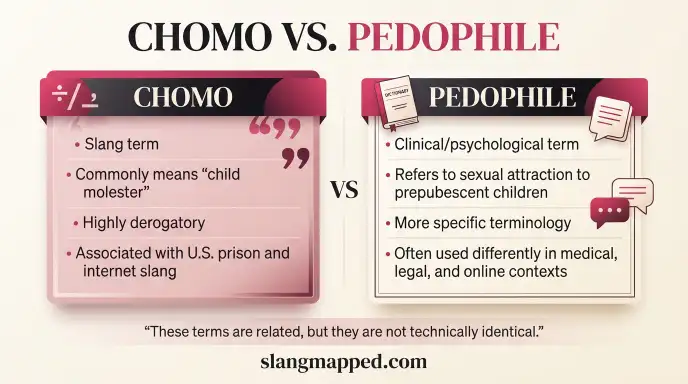
Chomo and pedophile are sometimes treated as synonyms online, but they are not technically identical.
A child molester generally refers to a person who sexually abuses a child. Pedophile is a clinical term associated with sexual attraction to prepubescent children.
A person can use these terms loosely online, but responsible communication should recognize the difference.
| Term | General meaning | Tone |
| Chomo | Slang for child molester | Highly derogatory |
| Child molester | Person who sexually abuses a child | Serious and direct |
| Pedophile | Clinical term relating to sexual attraction to prepubescent children | Clinical, but often used offensively online |
| Sex offender | Broad term for a person convicted of a qualifying sexual offense | More formal |
Why the Difference Matters
Using precise language is especially important when discussing real people.
For example, an allegation should not be presented as a conviction. Similarly, a clinical term should not automatically be treated as proof that someone committed a specific criminal offense.
Chomo vs. Other Slang Terms
Several slang terms may appear in discussions about sexual offenses, but they have different histories and meanings.
| Term | General meaning | Common context |
| Chomo | Child molester | U.S. prison and online slang |
| Pedo | Informal short form associated with pedophile | Internet and casual speech |
| Nonce | British slang associated with a sex offender | British prison slang |
| Sex offender | Person convicted of a qualifying sex offense | Formal and general discussion |
| Child molester | Person who sexually abuses a child | Direct and factual language |
These words should not automatically be treated as exact equivalents.
Origin and Background of Chomo
The history of chomo slang is closely connected with U.S. prison culture.
The word is commonly explained as a shortened blend of child and molester. Historical references show the term being used in prison-related contexts, including documented examples from the early 2000s.
Over time, prison vocabulary has spread into popular culture through books, documentaries, television, online forums, and social media.
As a result, people who have never been involved with prison culture may now encounter words such as “chomo” online.
How the Meaning Spread Online
The internet allows slang from specific communities to reach much larger audiences.
A term that once appeared mainly in prison-related conversations can eventually show up in:
- Viral videos
- Comment sections
- Memes
- Forums
- True-crime content
- Social media debates
This wider exposure does not necessarily create a new meaning. Instead, it introduces an existing slang term to people who may not know its background.
Why Do People Use Chomo Slang?
There are several reasons someone might use the term.
To Describe a Convicted Offender
Someone discussing prison culture may use “chomo” as slang for a person convicted of a crime involving sexual abuse of a child.
To Express Strong Disapproval
The term can communicate anger or disgust toward someone believed to have harmed a child.
To Make an Online Accusation
Some users employ the word when accusing another person of inappropriate behavior.
This is one of the most problematic uses because an accusation is not automatically evidence.
To Repeat Internet Slang
Some people simply copy terminology they have seen in videos, comments, or online communities without fully understanding its background.
When Should You Avoid Using Chomo?
In most everyday situations, it is best to avoid using chomo.
You should be especially careful when:
- Discussing an unverified allegation
- Talking about a real person
- Writing for school or work
- Communicating with parents or teachers
- Creating professional content
- Reporting a news story
- Speaking to children
- Posting publicly on social media
If the goal is to communicate information clearly, precise language is usually more appropriate.
Use Facts Instead of Labels
Instead of saying:
“He is a chomo.”
A factual statement could be:
“He was convicted of sexually abusing a child.”
Only use wording such as “convicted” when there is an actual conviction.
If there is only an allegation, say:
“He was accused of sexually abusing a child.”
This avoids presenting an allegation as a proven fact.
Polite Alternatives to Chomo
There is no perfect “polite” replacement for a serious accusation, but several terms are more precise.
Depending on the situation, you could use:
- Child molester
- Child sexual abuser
- Person accused of child sexual abuse
- Person convicted of child sexual abuse
- Sex offender
The correct term depends on what is actually known.
Choose the Term Based on the Facts
If someone has been convicted, “person convicted of child sexual abuse” is precise.
When someone has only been accused, “person accused of child sexual abuse” is more appropriate.
If you are discussing the general subject rather than a specific person, “child sexual abuse” may be the clearest term.
Impact of Using Chomo in Communication
Using this slang can have a strong effect on communication.
The term can immediately make a conversation more emotional and confrontational.
It may:
- Escalate an argument
- Damage someone’s reputation
- Make readers uncomfortable
- Turn a factual discussion into an emotional one
- Create misunderstandings
- Result in moderation problems on some platforms
For educational or professional communication, neutral wording usually produces a clearer discussion.
Impact on Online Conversations
Online conversations move quickly, and readers may not know if an accusation is supported by evidence.
A single comment calling someone a “chomo” can therefore be misunderstood as a statement of fact.
That is one reason responsible users should distinguish between verified information, allegations, opinions, and insults.
Is Chomo Safe for Social Media?
The word itself is not a harmless abbreviation. It refers to a serious subject and may be considered offensive or abusive depending on how it is used.
If a particular post violates a platform’s rules depends on the surrounding content and the platform’s policies.
Safer Social Media Usage
If you are explaining the word for educational purposes, you can say:
“Chomo is offensive slang for child molester.”
This is different from directing the term at a specific person.
When discussing real people, avoid presenting rumors or unverified accusations as facts.
Common Misunderstandings About Chomo
Chomo Is Not a Friendly Slang Word
Unlike terms such as “bro” or “bestie,” chomo does not normally have a harmless social meaning.
Chomo Is Not a Formal Legal Term
It is slang rather than the name of a criminal charge.
Legal systems use specific offense names and statutory definitions.
Calling Someone a Chomo Does Not Prove Anything
A social media user can make an accusation without evidence. The word itself is not proof of criminal behavior.
Chomo and Pedophile Are Not Perfect Synonyms
Although people may use the words interchangeably online, their technical meanings can differ.
Chomo Meaning in Text and Tone
When you see chomo meaning slang in a message, the tone is usually very negative.
The term may signal:
- Anger
- Disgust
- Accusation
- Hostility
- Condemnation
- Discussion of criminal behavior
It is therefore important to understand the context before repeating the term.
How to Respond If Someone Uses Chomo
If someone uses the word during an argument, you do not need to repeat it.
You can respond with a neutral question such as:
“What evidence are you referring to?”
Or:
“Are you saying the person was accused or convicted?”
These responses help separate claims from established facts.
Frequently Asked Questions
Q1. What does chomo mean in text?
Chomo usually means child molester. It is offensive slang associated with U.S. prison culture and is also used in some online communities.
Q2. What does chomo stand for?
The commonly understood chomo full form is child molester. It is generally considered slang rather than a formal acronym.
Q3. Is chomo a bad word?
Yes. Chomo is highly offensive and derogatory because it refers to child sexual abuse and can be used as a serious accusation.
Q4. Is chomo the same as pedophile?
Not exactly. “Chomo” generally refers to a child molester, while “pedophile” has a more specific clinical meaning. People may use the words loosely as synonyms online.
Q5. Where did chomo slang come from?
The term is strongly associated with U.S. prison slang. Its formation is commonly explained as a blend of “child” and “molester.”
Q6. Should I use chomo in everyday conversation?
Generally, no. It is highly offensive and can make a serious accusation against someone. More precise and factual language is usually better.
Final Takeaways
Chomo slang means “child molester.” It is a highly derogatory term strongly associated with U.S. prison slang and is now also seen in online discussions, social media comments, and internet arguments.
Although you may encounter chomo meaning in text on different platforms, it should not be treated like ordinary casual slang. The word carries a serious accusation and can have significant consequences when directed at a real person.
Context is especially important. A person may use the term while discussing a confirmed conviction, repeating an allegation, describing prison culture, or simply insulting someone.
For responsible communication, use precise language and clearly distinguish between an allegation and a proven fact.
Understanding both the meaning and the tone of chomo slang can help you interpret online conversations without accidentally repeating a harmful or unsupported accusation.
Read More Slang Terms:
- IMA Slang Meaning: More Than Just Texting Shorthand
- What Is Deuce Slang for Drug? 2026 Updated Guide
- BBL Slang Explained: Texting Slang vs. Pop Culture Usage

Hi, I’m Tyler Brooks, a writer specializing in Gen Z culture and internet slang. I track trending terms across TikTok and social media to explain their real-world meanings. My goal is to provide clear, accurate, and up-to-date definitions that help readers understand modern online language.